
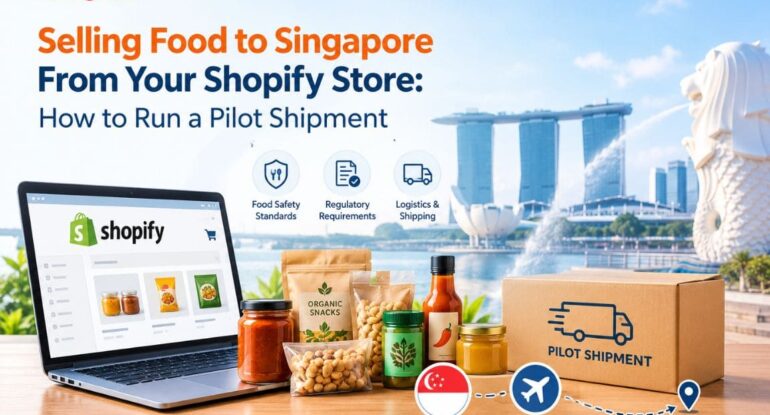
Selling Food to Singapore From Your Shopify Store: How to Run a Pilot Shipment (2026)
By Tam Nguyen | CEO, GOL Solution | 24+ years in international trade & cross-border logistics
Last Updated: September 2026
You can test the Singapore market with a very small food shipment from your own Shopify store, but a pilot does not exempt you from regulatory compliance. Selling food to Singapore from a Shopify store means the product has to be classified, labelled with a local importer’s name and address, and cleared under an import permit, even at 5 kg. What shrinks is the stock you put at risk, not the paperwork.
We recently answered an enquiry from an overseas seller planning exactly this: 50 or 100 retail packs of 100 g of a plain, sealed botanical leaf powder, sold through their own Shopify store, with no Singapore entity and no importer. Their seven questions set the order of this article.
For the full rules on food categories, labelling and licences, read our Singapore food guide. This article covers the small first shipment.
How Should You Classify the Product Before Anything Ships?
Classify the product first, because the answer changes every step after it. A plain, sealed powder sold with no health claims follows the Singapore Food Agency (SFA) food route. Claims about immunity, detox or dosage can push a product toward the Health Sciences Authority (HSA) rules instead.
We check the ingredient list, the label wording and the claims first or consult directly with the local agency, before freight is booked. If the product turns out to sit closer to a supplement, our supplement guide covers that pathway.
What Business Registration Does the Seller Need?
You do not need a Singapore company for a pilot, but your own business must be legally registered where you are based. Our know-your-customer (KYC) process for the certificate of incorporation or business registration certificate, plus the director’s ID or passport. For your supplier, standard food safety certification such as GMP, HACCP applies.
If your business is not registered yet, we cannot start, and we tell sellers to complete registration first. Once the documents are in hand, the Singapore set-up can begin.
What Must the Label Show for Singapore?
Food products must comply with SFA requirements for labels. Food products must contains Nutrition Information Panel (NIP), origin, product name and local importer details. Foreign food labels that do need meet the SFA standard can fulfill the requirements via supplement stickers.
GOL Insight
As part of the classification process, our team will review and advise if further modification on your label is required. If the current label do not meet SFA standard, a label review service is applied to advise brands on what needs to be modified.
What Registration and Permits Does a Pilot Need?
A pilot needs Food safety certification from the supplier, a SFA compliant food label and SFA import license, held by a local importer, plus an import permit for every consignment. Importing processed food for sale requires that registration. Only a business registered in Singapore, with a UEN activated with Singapore Customs, can hold that registration. An overseas seller therefore works through a local importer, and GOL takes that role for our clients. Each consignment then needs an import permit filed through TradeNet.
The set-up, which covers KYC, product classification and label review, generally takes two to three weeks. After that, the shipment permit can be processed one day before the shipment departs.
Does a Small Parcel Still Count as Commercial Import?
Yes. Small volumes do not turn a sale into a personal import. SFA states that you are deemed to be importing food for commercial sale even if you receive and sell food or samples by parcel post.
How Does Pilot Stock Reach Customers?
Most pilots ship as one consignment to a Singapore fulfilment point, with local delivery to customers from there. In general that means one permit for the pilot, instead of a permit and clearance cycle for every customer order. Confirm this against your own fulfilment plan before you commit.
For food brands that need warehouse partner in Singapore, we can introduce you to our current fulfilment partners. If your requirements call for sourcing a different partner, a separate sourcing fee applies.
What Does a Pilot Look Like Step by Step?
A pilot runs in five steps, and the first three fit inside a two to three week set-up.
Client Experience
An overseas seller with a Shopify store asked whether we could support a first shipment of either 5 kg or 10 kg of a plain botanical leaf powder. The seller had no Singapore entity, no importer and had not chosen a supplier yet. We said yes to trial shipments of that size, and yes to acting as the local importer once the seller’s business registration was in place.
| Step | What it involves | Timing in a pilot |
|---|---|---|
| 1. Classification and label review | Ingredients, claims and label wording, food certification checked against the food route | Part of the 2 to 3 week set-up |
| 2. KYC | Business registration certificate and director’s ID or passport | Part of the 2 to 3 week set-up |
| 3. Importer set-up | Local importer arranged, SFA import license in place | Part of the 2 to 3 week set-up |
| 4. Import permit | Filed through TradeNet for the consignment | One day before the shipment leaves |
| 5. Delivery | Fulfilment warehouse or direct delivery after clearance | After clearance |
Which Documents Does a Pilot Need?
A pilot needs five documents, and all of them come from the seller or the supplier.
| Document | Why it is needed | Who supplies it |
|---|---|---|
| Product label | Starting point for classification and label review | Seller or supplier |
| Ingredient list | Classification and claims check | Seller or supplier |
| Lab test reports, such as heavy metals and microbiology where relevant | Shows the product meets Singapore’s limits for contaminants in food | Seller or supplier. We review them but do not run tests |
| Food Facility Certification (GMP, HACCP) | Food Facility must meed food safety standards | Seller or supplier |
| Business registration certificate | KYC | Seller |
| Director’s ID or passport | KYC | Seller |
Testing stays with the seller. We check the reports against Singapore’s limits before shipping, which is the quickest way to avoid a hold at clearance.
What Does a Pilot Not Make Cheaper?
The fixed steps, classification, KYC, label review and the first permit, take the same effort for 5 kg as for 500 kg. A per-shipment minimum service fee applies to every shipment. There is no monthly or annual volume commitment, so you are not tied to a minimum once the pilot ends.
The sensible comparison for a pilot is the fixed cost of getting set up against how much you learn about Singapore demand. If you expect to ship once and never again, set-up is the main cost. If you expect repeat orders, the set-up is done and later shipments only need a permit.
When Does This Approach Not Apply?
It does not apply in three cases.
- Meat, fish, eggs and fresh produce. These need licences and approved sources on top of registration, so they are not a light-touch pilot. Our food guide covers them.
- Products with health or medicinal claims. These move to the HSA pathway, which is a different process from the SFA food route in this article.
- Sellers without a registered business. Our KYC step needs registration documents, so the business has to exist first.
FAQ
Is a small parcel sold to a customer still a commercial import?
Yes. SFA treats receiving and selling food or samples by parcel post as importing for commercial sale, so registration and permit rules apply from the first shipment.
Do I need my own Singapore company to test with a Shopify store?
No. A local importer holds the SFA registration and files the permit. Your own business does need to be registered in the country where you operate, because that registration is what our KYC step checks.
Does a 5 kg pilot need SFA registration?
Registration applies to importing processed food for sale, whatever the volume. The local importer holds it, so you do not register yourself.
Who does the lab testing?
The seller or supplier provides test reports. We review them against Singapore’s contaminant limits but do not commission or run tests.
How long before the first shipment can leave?
Set-up usually takes two to three weeks from the point we have your documents and label. The permit is then processed one day before the shipment arrives.
How Do You Get Started?
Send us your label, ingredient list and business registration certificate if you are planning a small first shipment to Singapore from your Shopify store. We will tell you how the product classifies, what your set-up covers and what the first shipment involves, before you commit to anything.
Talk to our Singapore team about running your pilot shipment.