
How to Sell Supplements in Singapore as a Foreign Brand: A Real Market Entry Case Study
Which of those categories applies to each of your SKUs is not always obvious, and it is not something you want to discover after your goods have landed.
We completed a Singapore market entry for a Southeast Asian DTC supplement brand earlier this year. Nineteen SKUs, 14 in capsule form and 5 in loose powder, no prior cross-border regulatory experience. The full process from first assessment to shipment readiness took under three months. What follows is a full account of what that looked like.
The Client
A Southeast Asian DTC supplement brand with 19 SKUs decided to expand regionally into Singapore, Malaysia, Thailand, and Vietnam at the same time. They had no prior cross-border regulatory experience and no internal compliance team.
Their goal was to start fulfilling orders in Singapore as quickly as possible while compliance work for the other three markets ran in parallel.
Phase 1: Classification – Finding Out What Can Actually Enter Singapore
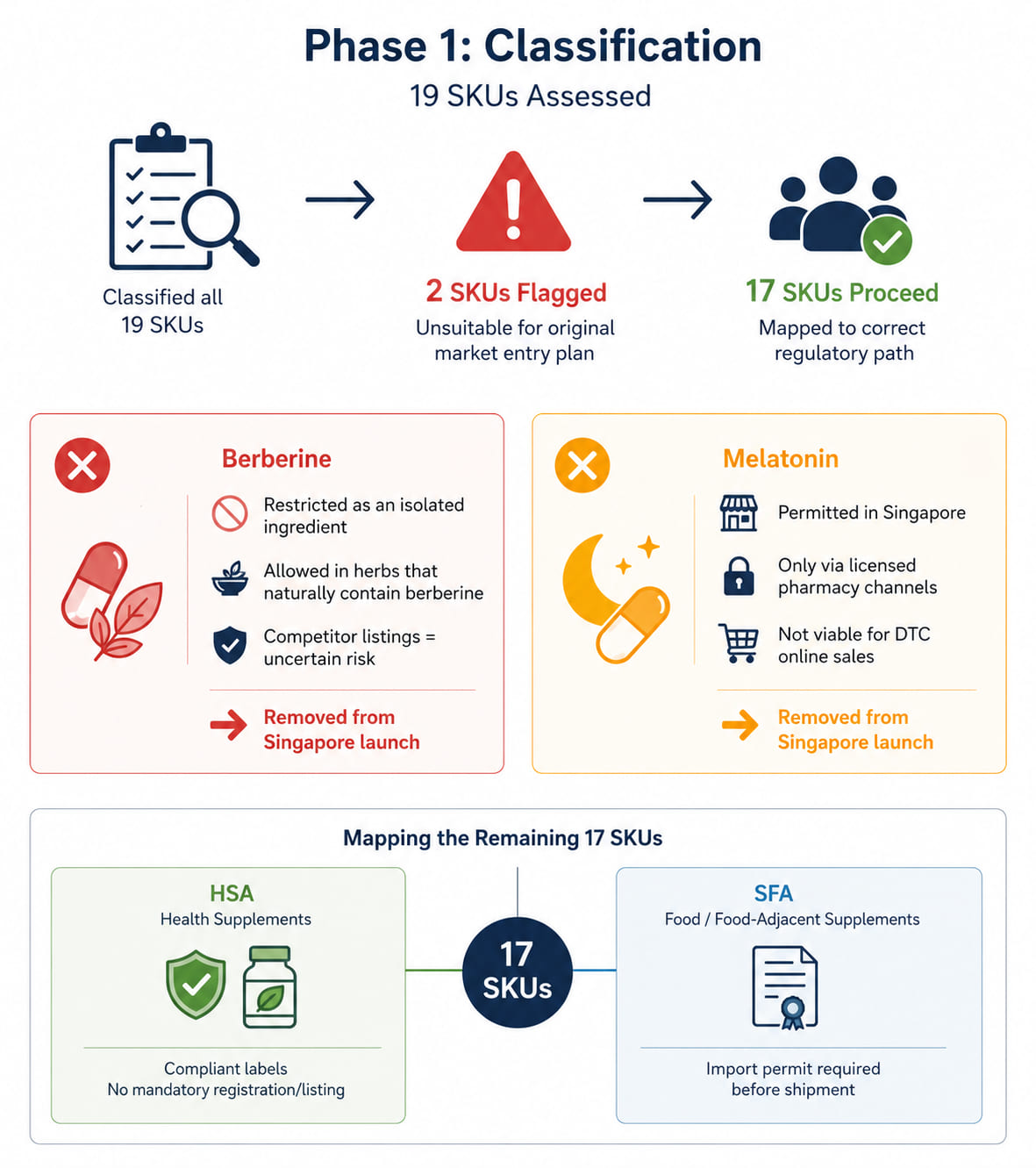
Before anything else, we ran a classification assessment across all 19 SKUs. The client had not done any pre-classification work before coming to us. They had budgeted for all 19 products to launch in Singapore and had not yet considered that some might not be permitted.
In Singapore, health supplements do not fall under a single regulatory body. HSA governs products that make health claims. SFA governs food products, including some supplements in food-adjacent categories. Getting this wrong means either shipping without the right import permits (an SFA violation) or spending time and money on compliance steps that your product category does not need.
Two products were immediately flagged as unsuitable for the client’s original market entry plan.
Berberine: Where the Client Pushed Back
The first product contained berberine as a listed ingredient. Berberine is restricted in Singapore and cannot be imported or sold as a supplement ingredient.
The client came back to us after doing their own internal check. They had found an HSA press release that appeared to permit berberine in the Singapore market, and they wanted to know why we were advising against it.
This is where the detail matters. Singapore does allow traditional Chinese medicine herbs that naturally contain berberine to be sold. What is not permitted is berberine as an isolated, standardised ingredient in a health supplement. The two are treated differently under Singapore’s regulatory framework. The HSA communication the client found referred to the former, not the latter.
They had a second concern. Searching on Lazada, they could see other brands already listing berberine supplements for sale in Singapore. If competitors were doing it, why could they not?
We gave them a direct answer. We do not know what registration status, if any, those sellers have. Because HSA listing for health supplements is voluntary, some sellers list the product and take their chances with post-market surveillance. They may never be flagged. They may face a recall next month. We do not recommend our clients follow that path, particularly for a brand building a long-term regional presence. A recall or an agency penalty at the start of a regional expansion is a brand problem, not just a compliance problem. Our advice was to remove the berberine SKU from the Singapore launch and revisit if the regulatory position changes.
The client accepted this after the explanation. The product was pulled from the Singapore SKU list.
GOL Insight The berberine question comes up more often than you would expect. The confusion usually starts in the same place it started here — a legitimate HSA communication about Chinese herbal medicine that gets read more broadly than it was intended. The line between a herb that naturally contains berberine and berberine as an ingredient is meaningful to the regulator and not visible to most brands. When a client finds a competitor listing a restricted product on a marketplace, our job is to explain what we know, what we do not know, and what the risk profile of each path looks like. We cannot make that decision for the client, but we can make sure they are not making it without the full picture.
Melatonin: Asking HSA Instead of Guessing
The second flagged product was a melatonin supplement. Melatonin is generally regulated in Singapore as a prescription drug, so our initial assessment was that it could not launch as a supplement.
The client kept asking whether we were sure. They could see competitor melatonin supplements on Singapore shelves and wanted to know why theirs would be treated differently. Rather than rely on a general rule, or on what competitors appeared to be doing, we submitted a product classification request to HSA for this specific formulation to get a definitive answer.
HSA responded that the product falls under complementary health products (CHP), which do not require HSA registration. That gave the client a documented basis to import it, and melatonin launched in Singapore with the rest of the range. The classification request ran within the same engagement, so it did not extend the overall timeline.
That result applies to this formulation. A melatonin product with a different dose, format or claims could be classified differently, which is why we treat each one as a case by case decision.
Mapping the Remaining 18 SKUs
For the remaining 18 SKUs, we mapped each one to either HSA or SFA jurisdiction. Products under HSA could enter the Singapore market as long as their labels were compliant. No mandatory registration or listing required. Products under SFA required an import permit before shipment. This mapping determined what each product needed before it could move.
Phase 2: Label Review – What Singapore Requires That Most Foreign Labels Get Wrong
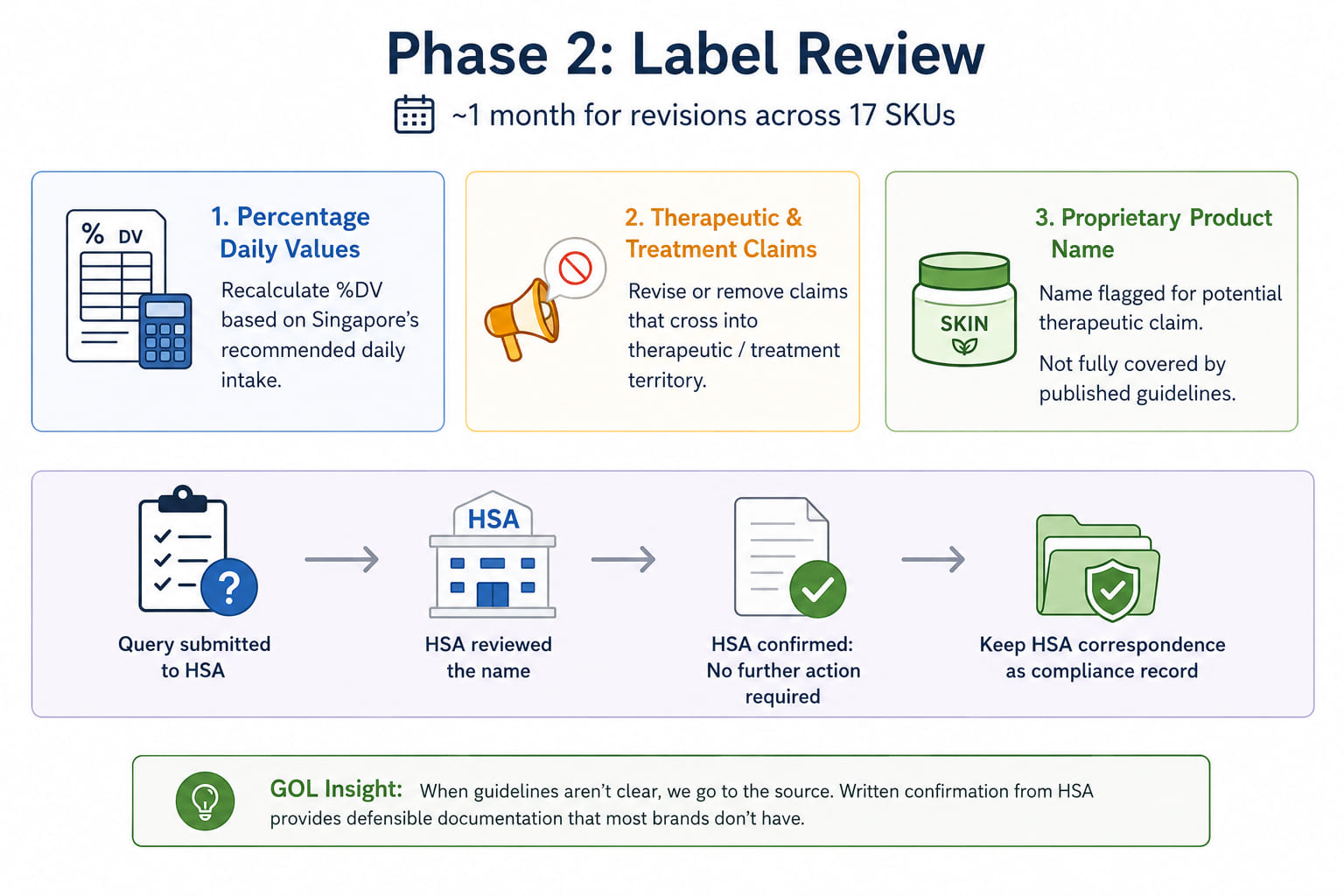
Label review began once classification was confirmed. Both sides took about one month to work through revisions across the 18 proceeding SKUs.
Percentage Daily Values
The client’s labels used percentage daily values calculated against the dietary reference values of their home country. Singapore’s recommended daily intake figures are different. Every label showing a percentage daily value needed to be recalculated against Singapore’s standards before printing.
This is one of the most common errors we see from brands entering Singapore from other parts of Asia. The ingredient quantity is identical. The percentage shown on the label is wrong.
Therapeutic and Treatment Claims
Several products carried advertising claims that crossed into therapeutic or treatment territory under HSA’s guidelines. These included claims about supporting specific health conditions and managing physiological functions in ways that HSA classifies as requiring drug registration, not supplement listing. These claims needed to be revised or removed before the products could proceed.
A Proprietary Product Name That Bordered on a Therapeutic Claim
One of the client’s skin health products used a specific proprietary product name as a core part of their marketing. The name itself, not just the advertising copy around it, implied a physiological function that our internal classification process flagged as potentially crossing into therapeutic claim territory under HSA’s framework.
Published HSA guidelines do not fully resolve this type of case. A product name that suggests treatment or physiological function can cross the line from supplement marketing into therapeutic claims, which would require a different registration pathway entirely. But the line is not always clear, and making the wrong call would either force an unnecessary product change or leave the client exposed.
We contacted HSA directly and submitted the specific product name for guidance. HSA reviewed it and confirmed that no further action was required. The product name did not trigger a therapeutic claim classification under their assessment.
We advised the client to keep the full HSA correspondence as part of their compliance records: the query we submitted and the response received. If HSA conducts a post-market audit or a retailer asks for documentation, a written response from the agency itself is the strongest evidence available. It is not a registration, but it is a defensible record that most brands do not have.
GOL Insight When we run into a question that published guidelines do not answer clearly, we go to the source. Most consultants will give you their best interpretation and move on. We prefer to get HSA’s position in writing, even if it takes a few weeks. In this case, the written response from HSA cleared the product name and gave the client documentation they can use if the question ever comes up again. That is worth more than an opinion.
Phase 3: Customs Brokerage
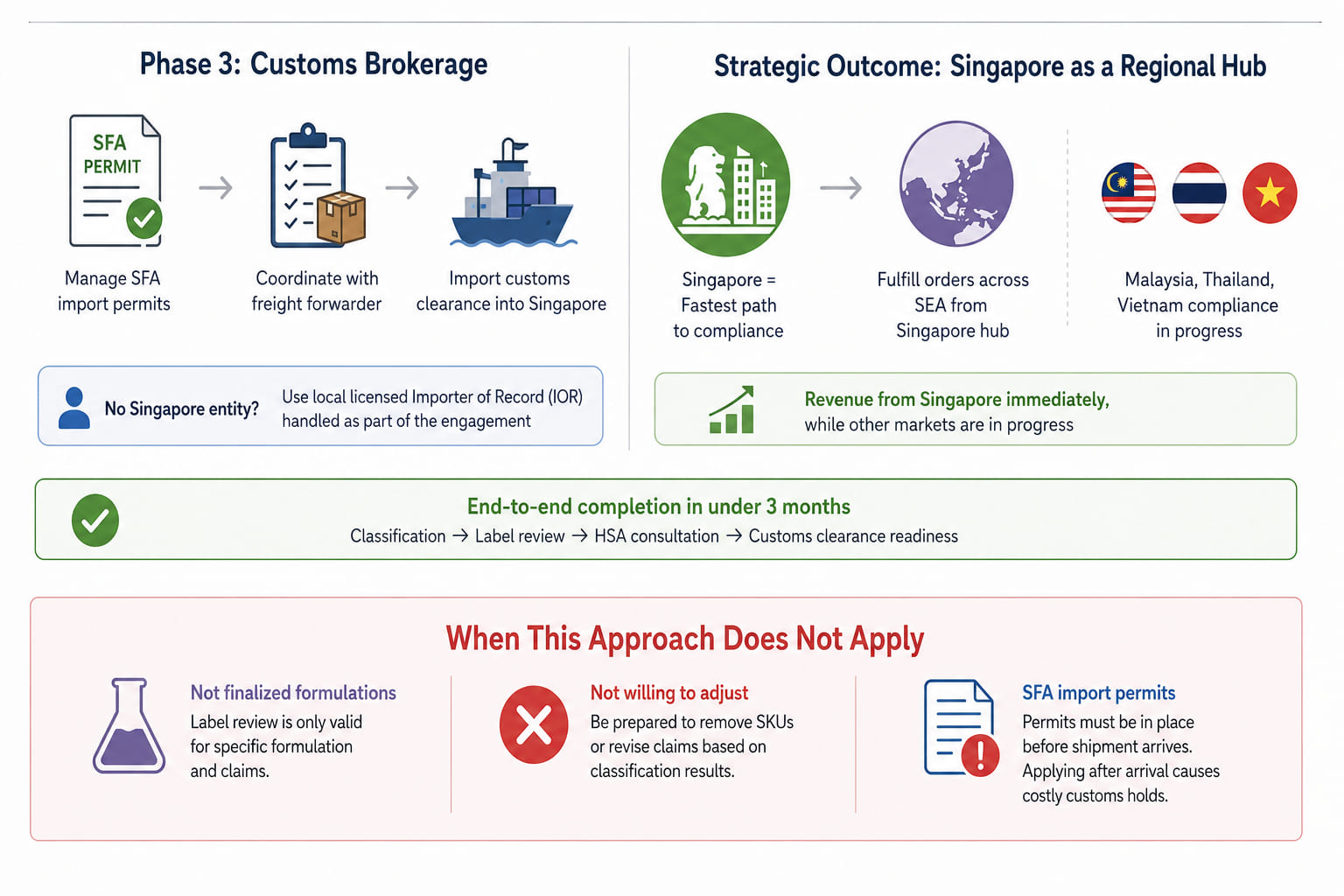
When the shipment was ready, GOL handled import customs clearance into Singapore. This included managing the SFA import permits for the relevant SKUs and coordinating with the freight forwarder on documentation requirements.
For brands without an established Singapore entity, the import process requires either working through a local licensed importer of record (IOR). We handled this as part of the same engagement, so the client did not need to source and brief a separate logistics partner.
The Strategic Outcome: Singapore as a Regional Hub
One outcome we had not originally planned to highlight became the most commercially significant finding of the engagement.
Because we ran the classification assessment for all four target markets at the same time, we had a comparative view of the regulatory requirements across Singapore, Malaysia, Thailand, and Vietnam simultaneously. Singapore was the fastest path to compliant market entry. It was not close.
This meant the client could begin fulfilling orders across their target region from a Singapore hub while the more complex compliance work for Malaysia, Thailand, and Vietnam was still in progress. Instead of waiting for all four markets to clear before shipping anything, they could generate revenue from Singapore immediately.
The full Singapore market entry, from classification through label review, HSA consultation, and customs clearance readiness, was completed in under three months.
When This Approach Does Not Apply
This classification-first, label-second process works well for brands with a defined SKU range and a clear distribution channel strategy. It is less suited to brands that have not yet finalised their formulations, because a label review is only valid for the specific formulation and claims that were reviewed.
It also requires the brand to be prepared to act on what the classification reveals. One of this client’s 19 SKUs was removed from the Singapore launch plan entirely, and a second only proceeded after a formal classification request to HSA. Brands that are not willing to adjust their SKU list or revise claims will either stall the process or proceed with compliance risk.
Finally, if your product category requires SFA import permits, those permits need to be in place before your shipment arrives. Applying after the goods have landed creates a customs hold situation that is time-consuming and costly to resolve.
Working With GOL on Singapore Market Entry
GOL Solution provides end-to-end market entry services for supplement and nutraceutical brands entering Southeast Asia, covering regulatory classification, label consultation, agency liaison, and customs brokerage.
If you are planning a Singapore launch or a broader SEA market entry, the classification assessment is the right starting point. It tells you which products can enter, which channels each product can use, and what compliance work each SKU requires before you invest in label revisions or freight.
Do I need to register my supplements with HSA before selling in Singapore?
For most health supplements, HSA listing is voluntary. You are not required to register before selling, but your products must comply with HSA’s requirements for ingredients, dosage limits, and label claims. Certain product categories and ingredients are prohibited regardless of whether you have registered anything. Assuming that “voluntary” means “no rules apply” is the most common misread we see from brands entering Singapore for the first time.
What is the difference between HSA and SFA for supplements?
HSA oversees health supplements: products that make health or function claims. SFA oversees food products, including supplements that do not make health claims and fall into food-adjacent categories. Some supplement products are regulated by SFA rather than HSA depending on their ingredients and intended use. Knowing which regulator covers your product determines what import documentation you need and what label requirements apply.
Is berberine allowed in Singapore supplements?
No. Berberine is classified as a restricted substance in Singapore and cannot be imported or sold as a supplement ingredient. Traditional Chinese medicine herbs that naturally contain berberine are treated separately under a different framework. If your formulation lists berberine as an ingredient, it cannot enter the Singapore market regardless of dosage or format.
Can I sell melatonin supplements online in Singapore?
Melatonin is generally treated as a prescription drug in Singapore, so we recommend brands submit a product classification request to HSA to confirm whether their specific product can enter Singapore as a supplement. The outcome is case by case and depends on the formulation. In the case above, HSA classified the client’s melatonin product as a complementary health product (CHP), which does not require HSA registration, so it could be imported and launched with the rest of the range.
How long does Singapore supplement market entry take?
For a brand with finalised formulations and labels ready for review, the full process from classification through label consultation to import readiness typically takes two months, depending on the complexity of the SKU range and the number of revisions required. The engagement described in this article was completed in under three months, partly because the client still needed to finalize their product list and labels once the classification was confirmed.