

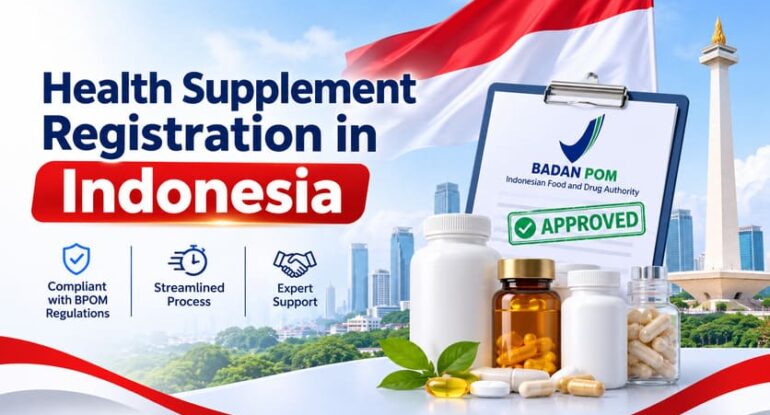
Health Supplement Registration in Indonesia: Complete Guide
Health supplement registration in Indonesia decides whether your product ships or sits in a warehouse. No supplement can be sold in the country without a marketing authorization (Izin Edar) from BPOM, the national food and drug regulator.
BPOM Regulation No. 19 of 2026 governs supplement registration and replaced the earlier rule. Older guides may still describe the previous one. This guide covers what you need before you file, how the process runs, and the mistakes that cost exporters months.
It answers four questions. What counts as a supplement? Who can file? How does the process run? Where do filings go wrong?
In short: BPOM Regulation No. 19 of 2026 governs supplement registration. Applicants are licensed Indonesian business operators, so a foreign brand usually needs a local partner to file. Most delays come from classification, claims, and formula limits, not from the volume of paperwork.
Classification: what counts as a supplement in Indonesia
BPOM defines a health supplement as a product that completes nutrient needs or supports and improves health function. It has a nutritional value or physiological effect. Its ingredients are vitamins, minerals, amino acids, or other non-plant substances, which may be combined with plant ingredients.
A supplement is not meant to prevent or treat disease. That line decides your pathway. A product that claims to treat a condition is a drug. A high-dose herbal extract may be a traditional medicine. Food supplement registration in Indonesia only covers products that fit the supplement definition, so confirm the category before you build a dossier. The wrong pathway means starting again.
Borderline cases include herbal extracts, fortified foods, and products with a medical-sounding purpose. A short classification check at the start protects the rest of your budget.
Vitamin registration in Indonesia: the lightest category
The regulation sorts new registrations into categories. Your formula decides which one you fall into:
| Category | What it covers |
|---|---|
| Category 1 (lightest) | A single vitamin or mineral with a known safety and benefit profile |
| Category 2 | A single active ingredient other than a vitamin or mineral, or a combination with a known profile |
| Category 3 (heaviest) | A new active ingredient or combination, a new dose, a new claim, a new dosage form, or an unknown safety profile |
That makes vitamin registration in Indonesia the most predictable route for many exporters. Category 3 products face stronger evidence expectations from BPOM, so budget more time for them.
Health supplement registration in Indonesia: what you need before you file
The rule took effect on the day it was promulgated, 3 November 2026. It revokes BPOM Regulation No. 32 of 2022 and its 2024 amendment. BPOM guidance can change, so confirm current requirements with an adviser before you commit budget.
Five things matter most:
- A licensed Indonesian applicant. The regulation names pharmaceutical companies, food manufacturers, and licensed distributors and importers as applicants. It sets no separate route for foreign brand owners, so in our reading you appoint an Indonesian partner to hold the filing. Product Registration Indonesia explains how this works for brands without a local entity in its overview of health supplement registration in Indonesia.
- Proof of quality. Show quality through testing at an accredited laboratory or through compliance with Good Manufacturing Practice (GMP). Have the overseas factory’s GMP documents ready early.
- Stability data. BPOM Regulation No. 6 of 2025 sets out how to design stability studies, evaluate the results, and state shelf life on the label.
- Ingredients and doses within BPOM limits. Check the formula against BPOM’s ingredient and dose limits before you lock it. Reformulating now costs less than refiling later.
- A compliant label. The regulation requires 17 items of label information. They include the product name, composition, claims, directions for use, warnings, the Izin Edar number, production code, expiry date, storage conditions, a 2D barcode, and the words “Suplemen Kesehatan”.
These requirements apply to vitamin registration in Indonesia too, even when the category is lighter.
Food supplement registration in Indonesia: how the process runs
Food supplement registration in Indonesia runs online. The sequence stays stable even when details change:
- Create the company account. The applicant registers through BPOM’s registration portal, and BPOM verifies the account.
- Submit the registration. Choose the type (new registration, variation, or re-registration) and the category, then upload the dossier.
- Answer BPOM’s evaluation. BPOM reviews safety, benefit, quality, and labeling, and may raise questions.
- Receive the Izin Edar. This is the permit that lets you sell.
Keep every document consistent. Names, addresses, and product details should match across the dossier, the GMP documents, and the label. Mismatches invite questions.
A typical dossier covers the formula and ingredient specifications, certificates of analysis, stability data, GMP documents, label artwork, and evidence for each claim. Build it in that order. The formula drives the stability data, and the claims drive the label.
Label review in Bahasa Indonesia, product classification, and customs clearance sit around the filing, not inside it. GOL Solution’s Indonesia market entry service covers them.
Timelines depend on the category, how complete the dossier is, and how fast you answer BPOM. Treat fixed promises with caution. Plan shipments and launch dates after approval, not before.
Pitfalls: five mistakes that cost exporters months
- Claims that read as medical. BPOM’s claim guideline (Regulation No. 19 of 2022) says claims must be objective, complete, and not misleading, and must not aim to prevent or treat disease. Words like “cure” or “treat” push a product toward drug rules. Claims copied from your home market deserve a second look.
- Wrong classification. A herbal medicine or a fortified food filed as a supplement usually means refiling under the right pathway. Settle this first.
- Formulas outside the limits. An ingredient or dose over BPOM limits stalls a dossier, and even vitamin registration in Indonesia stalls on dose limits. Fix the formula, then compile the documents. Keep supplier specifications and certificates of analysis for every ingredient.
- Marketing that outruns the label. Website copy, marketplace listings, and packaging imagery should say no more than the approved claims. Marketplace sellers should check every listing against the approved label before launch.
- A registration tied to the wrong partner. BPOM limits the registration right for the same product, formula, and overseas manufacturer to one importer. Choose before you file. Ask any candidate for their licenses and track record. A partner who cannot show licenses, or who will not share the registration documents, is a risk to your launch.
How do GOL Solution and Product Registration Indonesia work together?
Exporters usually need two things at once: a licensed Indonesian applicant for the BPOM filing, and a plan to get the product to buyers. Product Registration Indonesia, a Jakarta-based regulatory consultancy, covers the first by acting as license holder and preparing BPOM dossiers. GOL Solution covers the second through label review, product classification, and customs clearance. When a client enquiry needs registration support, GOL Solution brings Product Registration Indonesia in.
Checklist: what to confirm before you ship to Indonesia
Before you ship a sample or sign a distribution deal, confirm five points:
- The pathway: supplement, food, or herbal medicine.
- The formula, checked against BPOM ingredient and dose limits.
- Quality evidence: GMP documents or accredited laboratory results.
- Claim and label text matched to what BPOM allows.
- A named Indonesian applicant, appointed in writing.
Settle these first and health supplement registration in Indonesia becomes a planning exercise, not a series of surprises. If you are mapping out an Indonesia launch, GOL Solution’s Indonesia market entry page explains how the team supports exporters, from classification to delivery.
Frequently Asked Questions
How long is a supplement Izin Edar valid, and when do I renew?
An Izin Edar lasts up to five years, and BPOM sets the exact term after its evaluation. If the importer’s agency letter runs shorter than five years, the Izin Edar follows that letter. Renewal is a re-registration. It can be filed from 120 days before expiry, and the latest filing date is 60 days before expiry if the product changes or 15 days if it does not. Check how BPOM counts the days, and confirm the current rule before you file.
Can I keep selling products registered under the earlier rule?
Yes. Existing Izin Edar stay valid until they expire, and applications filed before 3 November 2026 continue under the earlier rule. A product that does not meet the regulation’s standards must be adjusted within two years of promulgation. Existing marketing and importer recommendations must be re-applied for within two years, or they are revoked.
What happens if I change my formula or label after approval?
Changes are filed as variations. A minor variation by notification is made first and reported within six months after the change. Other minor variations need BPOM’s approval, and major variations need approval too. Some changes must be filed as a new registration, such as adding a dosage form or changing a formula in a way that affects safety.
Do probiotic supplements follow a different path?
They are assessed under a separate guideline. BPOM Regulation No. 17 of 2025, set on 23 June 2025, covers supplements containing probiotics and replaced the 2021 version. Probiotics differ from other supplements because the active ingredient is a living microorganism. Confirm the current rule and the strain data BPOM expects before filing.



Leave A Comment