
How to Import and Sell Food Products in Singapore: A Complete Guide (2026)
Most foreign brands discover Singapore’s food import rules at the wrong moment after their shipment has left the warehouse. A protein bar arrives without a valid SFA import permit. A functional beverage is held because its claims pushed it into a different regulatory category. A meal replacement formula clears customs but fails a post-market audit because the nutrition label was calculated against the wrong daily reference values.
Understanding how to import food products into Singapore is not complicated once you know the framework. The Singapore Food Agency (SFA) regulates all food imports, and the central question is always the same: what category is your product, and does that category require a permit before your goods arrive? Get that answer right first, and the rest of the process follows a clear path.
This guide covers the full process for foreign e-commerce brands entering Singapore with food products in 2026: SFA import permits, food labelling requirements under the Singapore Food Regulations, product classification (including when your product might need to go through HSA instead of SFA), the Importer of Record structure for brands without a Singapore entity, and a comparison of timelines against other SEA markets. For special purpose food categories such as infant formula, sports nutrition, and weight management products, see our dedicated article: Special Purpose Food Registration in Singapore.
1. Who Regulates Food Imports in Singapore: SFA vs HSA
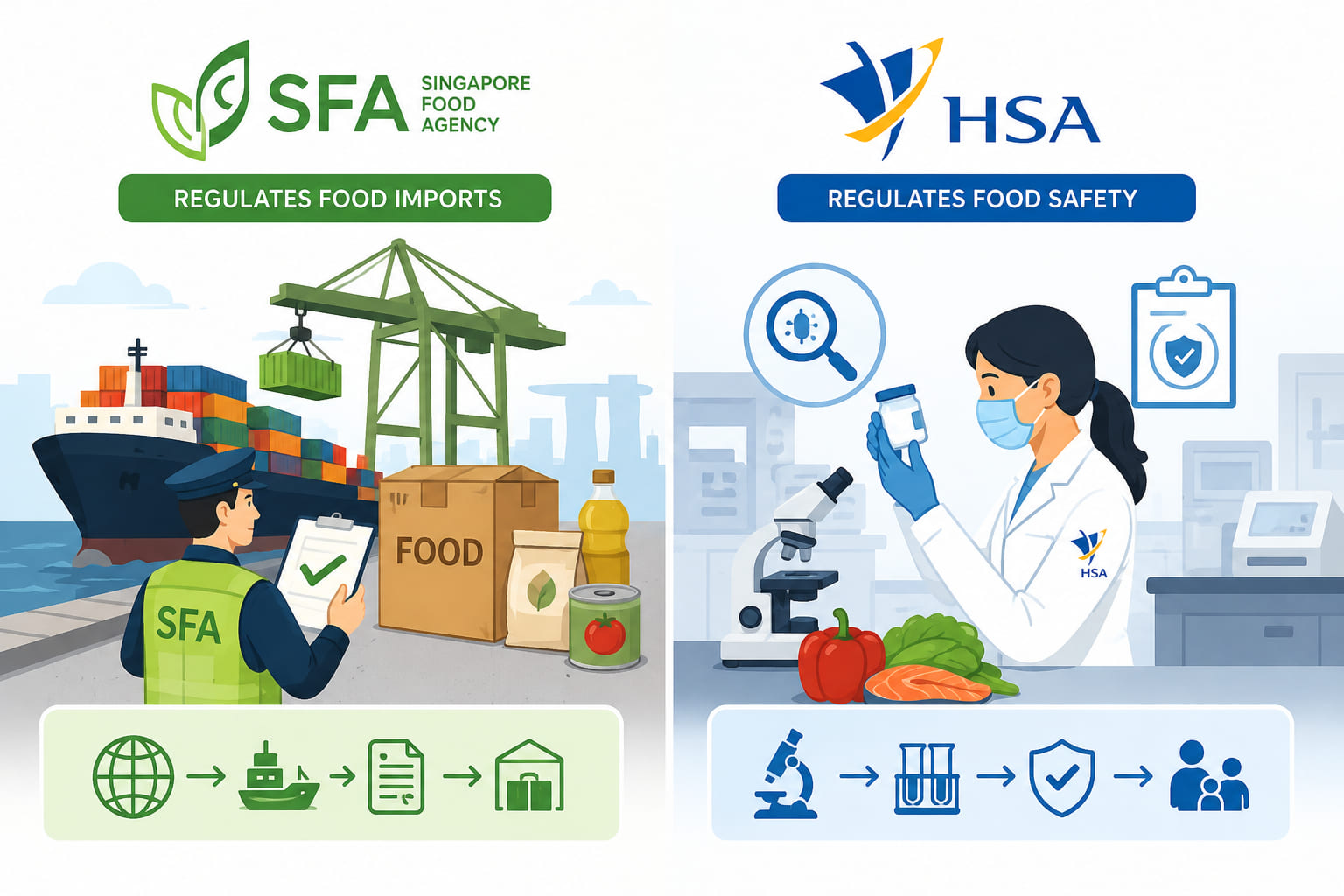
Singapore has two regulatory agencies that food and nutrition brands encounter. Knowing which one covers your product before you file anything is the single most useful thing you can do.
The Singapore Food Agency (SFA) administers the Sale of Food Act and the Food Regulations (Cap 283, Rg 1). SFA regulates all food products imported into Singapore, including conventional packaged food, beverages, condiments, snacks, baked goods, and functional foods that do not make specific health supplement claims.
The Health Sciences Authority (HSA) regulates health supplements under the Health Products Act. HSA covers products such as vitamins, minerals, herbal extracts, and amino acids taken orally to supplement the diet, presented in formats like capsules, tablets, or sachets with a defined unit dose.
The classification divides along two lines: format and claims. A turmeric product in a loose powder sachet that you stir into a drink falls under SFA as a food product. The same turmeric in a capsule with a defined daily dose and a label claim about joint health falls under HSA as a health supplement.
| GOL Insight: Classification Before Filing |
| We worked with a brand that wanted to bring a protein coffee product into Singapore. Under its composition and format (loose coffee powder), the product was classified as a food product under SFA. The brand also wanted specific function claims on the packaging, which meant we needed to consult with HSA directly before finalising the label. SFA and HSA have different labelling standards, and a label written for one agency’s framework will fail the other’s review. Getting the classification confirmed before artwork is finalised is always the cheapest step in the process. |
If your product sits in a grey area, for example a fortified drink powder with several health claims and no defined unit dose, we recommend a classification review before committing to any documentation. For a deeper look at when HSA jurisdiction applies to supplement-adjacent products, see our Singapore supplement market entry case study.
2. SFA Import Licences and Cargo Clearance Permits: What Every Commercial Importer Needs
Every business importing food commercially into Singapore needs two things from SFA: a company-level licence or registration, and a Cargo Clearance Permit (CCP) for every individual consignment. These are separate requirements. Having the company licence does not remove the need for a CCP on each shipment.
Licences and registrations are applied for through GoBusiness. CCPs are applied for through TradeNet before each shipment arrives. SFA takes at least one working day to review complete applications for either. Brands using an Importer of Record (IOR) service do not need to apply for licences or CCPs in their own name the IOR holds the relevant licences and manages the CCP application for each shipment.
Company-Level Licences by Food Category
The type of licence or registration required depends on what you are importing. Based on SFA’s published framework (last updated November 2025):
| Food Category | SFA Licence / Registration Required |
| Meat & Meat Products | Licence for Import/Export/Transhipment of Meat and Fish Products |
| Fish & Fish Products (including seafood) | Licence for Import/Export/Transhipment of Meat and Fish Products |
| Fresh Fruits & Vegetables | Licence for Import/Transhipment of Fresh Fruits and Vegetables |
| Shell Eggs | Licence to Import Shell Eggs |
| Processed Eggs | Registration to Import Processed Food Products and Food Appliances |
| Processed Food & Food Appliances (packaged snacks, beverages, condiments, biscuits, cooking oil, mineral water, etc.) | Registration to Import Processed Food Products and Food Appliances |
| Rice | Separate rice import licence via the SFA rice website |
Source: SFA Businesses that Need Licence / Permit / Registration for Import / Export (sfa.gov.sg), last updated November 2025.
The CCP: Required for Every Commercial Consignment of Processed Food
Beyond the company licence, every consignment of processed food imported for commercial sale must be accompanied by a valid CCP. SFA states this clearly: all imports of processed food and food appliances intended for sale must have a valid permit per consignment. This applies to packaged snack food, beverages, condiments, and all other processed food categories not only the higher-risk items.
Note that selling food received by parcel post also counts as commercial import under SFA rules. This means e-commerce brands receiving inventory in smaller parcel consignments are still subject to the CCP requirement.
Higher-Risk Categories: Additional Requirements on Top of the CCP
Certain categories carry additional requirements beyond the standard CCP. SFA administers two programmes for these:
Regulated Source Programme applies to processed food considered high-risk. Categories covered include: infant formula (0 to 12 months), infant cereal, pasteurised liquid milk, packaged mineral and drinking water, minimally processed fruits and vegetables, coconut milk and grated coconut, traditional cakes, mooncakes, cut sugarcane, and land snails. Each consignment must meet additional documentation requirements.
Enhanced Regulated Source Programme applies to food imported from Malaysia. Each consignment must come from a registered establishment.
For meat and eggs, SFA requires import only from SFA-approved sources or accredited overseas establishments, and each consignment must be accompanied by a health certificate from the Competent Authority of the exporting country. Fish and fish products that are not classified as high-risk can be imported from any country without a health certificate but high-risk seafood such as frozen oysters, live cockles, and certain shellfish has specific restrictions including country-of-origin limits and product testing.
The full list of high-risk products and their document requirements is published by SFA at sfa.gov.sg/food-import-export/commercial-imports/import-requirements-for-food-food-products. SFA’s Accreditation Database for Overseas Sources should be checked before each consignment, as approved sources are updated regularly.
3. General Food vs Special Purpose Food: Which Category Applies to You
Singapore’s food regulatory framework divides products into general food and special purpose food. The distinction determines which labelling standards apply and whether additional compositional requirements exist.
General Food
Most imported packaged food falls into this category: snacks, ready meals, sauces, beverages, confectionery, baked goods, dried ingredients, and similar products. General food products must comply with the Singapore Food Regulations on composition, permitted additives, and labelling, but are not subject to category-specific composition standards.
Special Purpose Food
Special purpose food is defined in Part X of the Food Regulations (Cap 283, Rg 1). The regulated categories are: low-calorie food, diabetic food, foods containing phytosterols or phytostanols, infants’ food, infant formula, and infant milk preparations.
These categories have mandatory compositional thresholds and specific labelling requirements beyond the general food rules. Infant formula, for example, has the most document-intensive requirements of any food category entering Singapore, including health certificate submission from the exporting country’s competent authority and six-monthly microbiological QC reports to SFA.
Sports nutrition products and weight management food do not qualify as special purpose food under Singapore law. They are regulated as general food (or health supplements under HSA if they make specific function claims and use defined unit doses). For the full breakdown of special purpose food categories and their requirements, see our article: Special Purpose Food Registration in Singapore.
4. Pre-Approval vs Compliance-Based Entry: What Singapore Actually Requires
One of the most common misconceptions about importing food into Singapore is that there must be a formal registration number or approval certificate before selling. For most food categories, that is not how it works.
Singapore operates a compliance-based framework for food. Your product must meet the compositional and labelling requirements in the Food Regulations before it goes on sale. SFA enforces these standards through post-market surveillance, product sampling, and audit not through a pre-approval gate that every product must pass through.
What this means in practice: the responsibility to get it right sits with the importer or distributor, not with SFA. There is no application process to catch errors for you. If your product fails a post-market check, SFA can require immediate withdrawal, relabelling at your cost, or enforcement action under the Sale of Food Act.
The exceptions to this compliance-based approach are the permit-required categories listed in Section 2 above, and infant formula, which requires notification to SFA before or upon market introduction. For those categories, there are formal steps that must be completed before the goods arrive.
Novel Food
Singapore introduced a novel food framework in 2019, covering foods that do not have a history of safe use in Singapore, including cell-cultivated meat, insect protein, and certain algae-derived ingredients. Novel food requires a formal safety assessment submission to SFA before it can be sold. The framework is still evolving, and SFA publishes its novel food guidance at sfa.gov.sg. If your product contains ingredients with no established commercial use in Singapore, a novel food pre-check is worth doing early.
SFA Approved Novel Foods (as of March 2026)
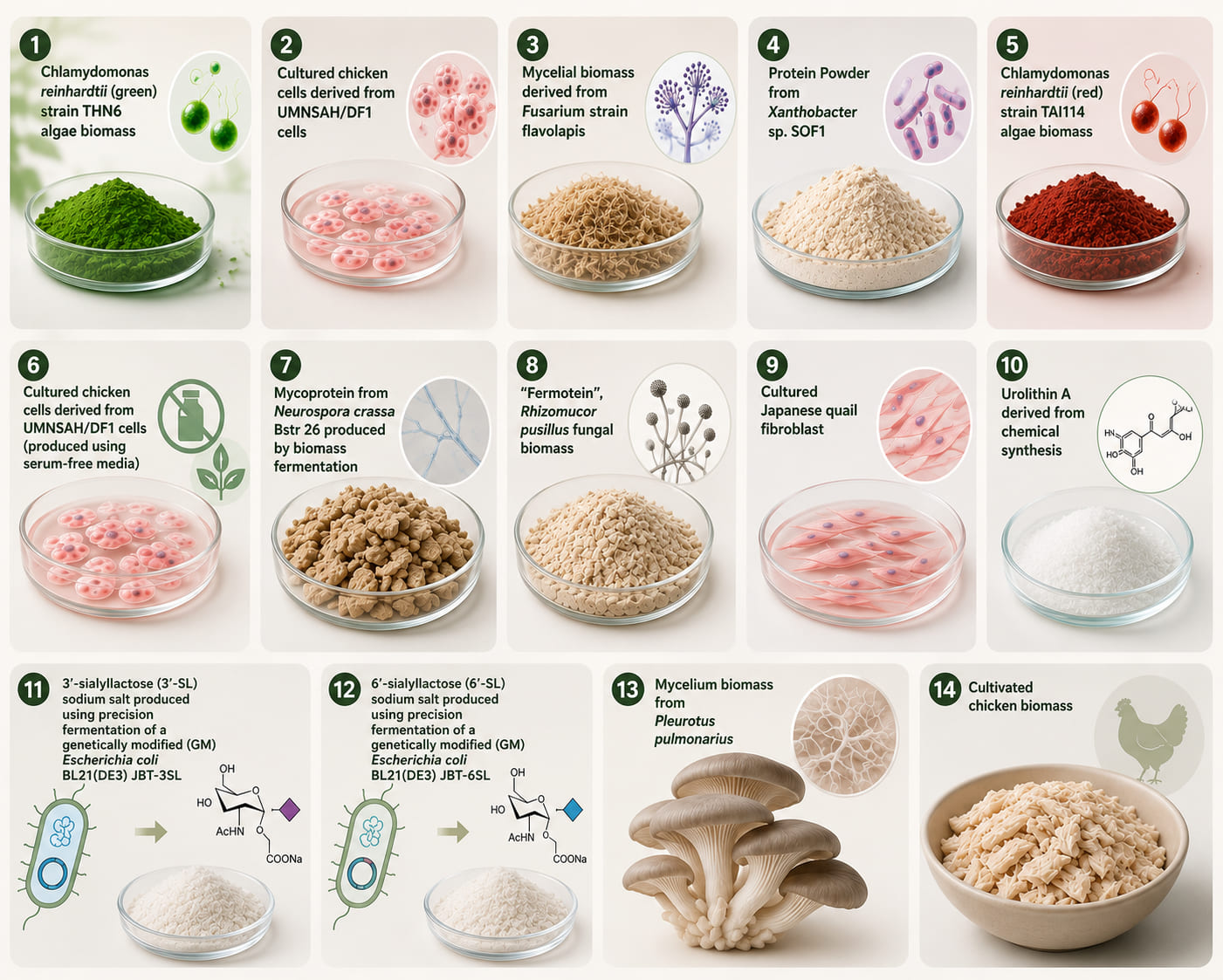
As of March 2026, SFA has approved the following 14 novel food products for sale in Singapore. Approval is product- and producer-specific a novel food ingredient approved for one manufacturer does not grant approval to another manufacturer producing the same ingredient.
| # | Approved Novel Food |
| 1 | Chlamydomonas reinhardtii (green) strain THN6 algae biomass |
| 2 | Cultured chicken cells derived from UMNSAH/DF1 cells |
| 3 | Mycelial biomass derived from Fusarium strain flavolapis |
| 4 | Protein Powder from Xanthobacter sp. SOF1 |
| 5 | Chlamydomonas reinhardtii (red) strain TAI114 algae biomass |
| 6 | Cultured chicken cells derived from UMNSAH/DF1 cells (produced using serum-free media) |
| 7 | Mycoprotein from Neurospora crassa Bstr 26 produced by biomass fermentation |
| 8 | “Fermotein”, Rhizomucor pusillus fungal biomass |
| 9 | Cultured Japanese quail fibroblast |
| 10 | Urolithin A derived from chemical synthesis |
| 11 | 3′-sialyllactose (3′-SL) sodium salt produced using precision fermentation of a genetically modified (GM) Escherichia coli BL21(DE3) JBT-3SL |
| 12 | 6′-sialyllactose (6′-SL) sodium salt produced using precision fermentation of a genetically modified (GM) Escherichia coli BL21(DE3) JBT-6SL |
| 13 | Mycelium biomass from Pleurotus pulmonarius |
| 14 | Cultivated chicken biomass |
Source: SFA List of Approved Novel Foods, March 2026. Approval is product- and producer-specific.
5. Food Labelling Under the Singapore Food Regulations
Labelling is where most imported food products run into compliance problems. A label approved in South Korea, Australia, or the EU will rarely transfer to Singapore without changes. The standard requirements under the Singapore Food Regulations apply to every packaged food product sold in Singapore.
Mandatory Label Elements
| Label Element | Requirement |
| Product name | Must accurately describe the food; cannot be misleading |
| Ingredient list | Descending order by weight; all ingredients declared |
| Quantity and Drained weight | The net quantity of the food in the package expressed in terms of
(i) Volumetric measure (for liquid food products) (ii) Net weight (for solid food products) or (iii) Either volumetric or weight measure for semi-solid of viscous products Drain weight is the weight of the food minus the liquid medium, and applies only to food packed in liquid medium. |
| Country of origin | Must state where the food was manufactured or substantially transformed |
| Importer / distributor name and address | Must be a Singapore-based entity; IOR satisfies this requirement |
| Lot / batch identification | Required for traceability in the event of recall |
| Directions for use or handling food | Effect from 30 Jan 2026. Directions on the use or handling of the food are only mandatory if the incorrect use or handling of the food would render the food unsafe or unsuitable. |
| Language | English is mandatory; additional languages are permitted but English must be present |
Nutrition Information Panel
Singapore requires a nutrition information panel (NIP) on most packaged food. The panel is administered by the Health Promotion Board (HPB) and must be formatted according to HPB’s prescribed template, which differs from the EU, US, and Australian formats that most foreign brands are accustomed to.
The panel must declare energy (in kilojoules and kilocalories), protein, total fat, saturated fat, carbohydrates, and sugars as a minimum. Additional nutrients can be declared voluntarily or must be declared if a nutrient content claim is made. Percentage daily values must be calculated against Singapore’s recommended dietary allowance (RDA) figures, which are published on the HPB website. Using the daily values from your home country is a label error that appears frequently and is straightforward to avoid.
Health and Nutrition Claims
Singapore follows the ASEAN framework on permitted nutrition and health claims for general food. Nutrient content claims such as ‘high in fibre’ or ‘low in sodium’ are permitted if the product meets the defined thresholds. Health claims referencing a relationship between a food component and a health outcome require substantiation and must not cross into therapeutic claim territory, which would trigger drug registration requirements under the HSA framework.
Products making claims that are standard and approved in other markets, including the EU health claims register or FDA qualified claims, cannot assume those claims are transferable to Singapore. Each claim needs to be checked against SFA and HPB guidelines before printing.
Sugar-Free and No Added Sugar Claims
A product may carry a ‘sugar-free’ claim in Singapore only if it contains 0.5g or less of sugar per 100g or 100ml. The definition of sugars in the Food Regulations is broader than most brands expect: it covers not just sucrose and fructose, but also maltodextrin, glucose syrups, starch hydrolysate, and sugars derived at a sugar refinery such as invert sugar. A product can be sucrose-free and still fail this threshold.
6. Importer of Record: How to Import Without a Singapore Entity
To import food into Singapore as a commercial consignment, the importer must be a Singapore-registered business entity holding the relevant SFA import licences. Foreign brands without a local Singapore company cannot fulfil this requirement directly.
The solution is an Importer of Record (IOR) service. An IOR is a Singapore-registered company that acts as the legal importer on your behalf. The IOR holds the relevant licences, applies for import permits where required, clears customs, and takes legal responsibility for regulatory compliance at the point of import.
From a practical standpoint, the IOR structure means your brand can begin selling in Singapore within days rather than months. You do not need to incorporate a Singapore company, open a local bank account, hire local staff, or apply for licences in your own name.
| GOL Insight: IOR in Practice |
| We handle IOR engagements regularly for food brands entering Singapore from South Korea, Japan, Taiwan, and Europe. The typical setup takes 3 to 5 working days from engagement to import readiness. Once the IOR structure is in place, it also satisfies the ‘importer name and address’ labelling requirement, which means brands using GOL as their IOR list our Singapore address on their Singapore-market labels. This is a detail that brands often discover too late after artwork has been printed. |
For brands planning to sell across multiple SEA markets, the IOR structure in Singapore combines well with a regional hub fulfillment model. Products are held in Singapore and fulfilled cross-border to Indonesia, Malaysia, Thailand, and Vietnam while compliance work for those markets runs in parallel. For the full strategic case, see our hub strategy article: Why Marketplace Winners Use Singapore as Their SEA Hub.
7. Timeline: Singapore vs Other SEA Markets
Singapore’s regulatory timelines for food market entry are faster than every other SEA market for most packaged food categories. The compliance-based framework means there is no waiting for a registration number before you can sell. The CCP and company registration can be in place within days of engagement.
| Market | Typical Timeline to First Sale |
| Singapore | 14 to 30 days (most packaged food categories via IOR) |
| Vietnam | 1 to 2 months (per-SKU registration required before import) |
| Malaysia | 1 to 2 months (with existing Halal cert); 4 to 6+ months if Halal certification needed foreign certs not transferable to Malaysia |
| Thailand | 2 to 4 months |
| Indonesia | 3 to 4 months |
Source: GOL Solution Singapore Market Entry Strategy article. Timelines reflect general packaged food market entry using an Importer of Record structure. Higher-risk categories and products subject to additional SFA requirements will take longer.
Thailand and Indonesia require pre-market product approval before most food categories can be sold, which drives their longer timelines. Vietnam also requires per-SKU product registration before import, the standard filing time is 7 days. However a recent bribery scandal in Vietnam Food Safety Authority has halted most application for supplements and food in 2026 so the realistic expectation will be 2-4 months. Malaysia does not require pre-market registration for all food categories, but Halal certification is a practical requirement for most products to gain retailer and marketplace acceptance. If your products are not already Halal certified, this adds 4 to 6 months and significant cost, and foreign Halal certificates are not transferable to Malaysia (local JAKIM or JAKIM-recognised certification is required).
Singapore has the most developed infrastructure for brands without a local entity, and its compliance-based framework (no pre-market registration for most general food) is what makes it the fastest first-launch market in the region.
8. When This Approach Does Not Apply
The Singapore-first strategy works reliably for most packaged food brands, but it fails in specific situations that are worth being clear about before you commit budget.
If your product margin is too thin to absorb cross-border fulfillment costs (typically SGD 8 to 20 per parcel to Indonesia or Malaysia), the Singapore hub model does not make commercial sense. Brands with a retail price below SGD 15 and no way to bundle orders will find the economics difficult. Registration in the target market first, even if it takes longer, is the more practical path.
If your product requires pre-market approval in the target country before any marketplace will list it, Singapore does not bypass that requirement. Singapore market entry gives you a Singapore presence. It does not grant regulatory status in other countries.
If your product contains restricted or novel food ingredients for Singapore, the compliance path is longer and requires agency consultation before any shipment. Brands that have not done a classification review before arrival discover this only after goods are held.
If your go-to-market depends on local distributors in Indonesia, Vietnam, or Thailand rather than direct-to-consumer sales, Singapore as a hub does not address what you actually need. Distributor negotiations happen in market, not from a Singapore warehouse.
FAQ: Importing Food Products into Singapore
Do I need an SFA import facility permit for all food products?
No. The facility permit requirement depends on the product category and the country of origin. Permit-required categories include meat, seafood, eggs, fresh produce, and infant formula. All processed food for commercial sale requires a Cargo Clearance Permit (CCP) per consignment via TradeNet. The company holding the relevant SFA licence or registration must be a Singapore-registered entity which is why most foreign brands use an IOR service.
What is the difference between SFA and HSA for food and nutrition brands?
SFA (Singapore Food Agency) regulates food products under the Sale of Food Act, including packaged food, functional food, and special purpose food categories. HSA (Health Sciences Authority) regulates health supplements under the Health Products Act, covering products like capsules and tablets with defined unit doses and health function claims. The determining factor is format and claims. Loose powder or liquid products without a defined unit dose route to SFA. Products in capsule or tablet form with a defined daily dose and health claims route to HSA. If your product sits between these two, a classification review before filing is worth the investment.
Can I list my food product on Shopee or Lazada Singapore without a Singapore company?
Marketplace seller accounts on Shopee Singapore and Lazada Singapore require a Singapore-registered entity. Brands without a local company use a Merchant on Record (MOR) service, which provides the required local entity structure for marketplace registration. The MOR handles the seller account and the IOR handles the physical import. Both can be provided by the same service partner, so you do not need to source them separately.
What nutrition labelling standard applies in Singapore?
The nutrition information panel format is set by the Health Promotion Board (HPB), not SFA. The mandatory nutrients, declaration format, and percentage daily value reference figures are HPB’s, and they differ from the EU, US, and Australian standards. Percentage daily values must be recalculated against Singapore’s recommended dietary allowance figures, which are published on the HPB website. This is one of the most common label errors we see on products entering Singapore from other markets.
How long does it take to start selling food products in Singapore?
For most packaged food categories, a brand with a finalised product and a label ready for review can be selling within 14 to 30 days of engagement. This covers IOR setup (3 to 5 working days), label review and any required revisions, and marketplace or website listing setup. Permit-required categories add time for permit applications, and products requiring label redesign take longer. Infant formula is at the more complex end of the timeline due to the additional documentation requirements.
Ready to Bring Your Food Products into Singapore?
GOL Solution handles food product classification, SFA import permits, label compliance review, IOR setup, and marketplace onboarding as a single engagement for foreign food brands. We have run this process for brands from South Korea, Japan, Taiwan, Australia, and Europe across categories including functional beverages, packaged snacks, specialty food, and special purpose food products.