
How to Export Food Products to Canada: A Complete Guide (2025 Update)
Why Export Food Products to Canada?
Canada is one of the world’s largest importers of food products, with a strong demand for high-quality international goods. Whether you are a food manufacturer, exporter, or distributor, exporting food products to Canada offers opportunities to tap into a diverse consumer base and premium markets.
However, Canada has strict food safety regulations, labeling rules, and licensing requirements. Failing to comply can lead to shipment delays, rejections, or penalties.
This 2025 guide walks you through the step-by-step process to successfully export food products to Canada, including licensing, certification, packaging, and logistics.
Step 1 – Understand Canadian Food Regulations
The Canadian Food Inspection Agency (CFIA) is the primary authority responsible for ensuring the safety, quality, and compliance of food products entering or leaving Canada. All exporters aiming to export food products to Canada must comply with the Safe Food for Canadians Regulations (SFCR), along with other relevant federal acts and industry-specific rules.
Failing to meet these requirements can result in shipment delays, product recalls, financial losses, and long-term trade restrictions—so understanding them from the outset is crucial.
1.1 General and Food-Specific Regulations
Different types of food are subject to different sets of rules under Canadian law. Before starting your export process, you need to identify exactly which regulations apply to your product:
- Meat, poultry, and seafood – Must meet additional inspection requirements, such as Hazard Analysis Critical Control Points (HACCP) compliance, and in some cases, must come from a facility approved by CFIA for export to Canada.
- Dairy products – Regulated under Canada’s supply management system, requiring special import permits. Exporters must also comply with compositional standards for milk fat and protein content.
- Processed foods – Must follow ingredient, additive, and preservative limits as defined under the Food and Drug Regulations (FDR). Certain additives that are legal in other countries may be prohibited in Canada.
- Fresh fruits and vegetables – Must meet Canadian Grade Standards for size, quality, and appearance. A phytosanitary certificate may be required to prevent the introduction of pests and diseases.
Pro tip: Always cross-check your product category against CFIA’s Automated Import Reference System (AIRS) to confirm applicable regulations before preparing shipment.
1.2 Licensing and Registration
Under the Safe Food for Canadians Regulations, licensing plays a key role in compliance.
- Canadian Importer License Requirement: Foreign exporters do not need a Safe Food for Canadians (SFC) license themselves. However, your Canadian importer must hold an active SFC license to bring your products into Canada. Without this, your shipment will be refused entry.
- My CFIA Account: All exporters—regardless of origin—must have a My CFIA online account to apply for export certificates, track application status, and manage communications with CFIA.
- Registration Timelines: Setting up your My CFIA account and preparing documents can take 2–4 weeks for first-time exporters, so plan ahead.
Pro tip: Some exporters mistakenly assume their freight forwarder can handle licensing. In reality, the importer’s license is legally tied to the entity responsible for bringing goods into Canada.
1.3 Preventive Controls
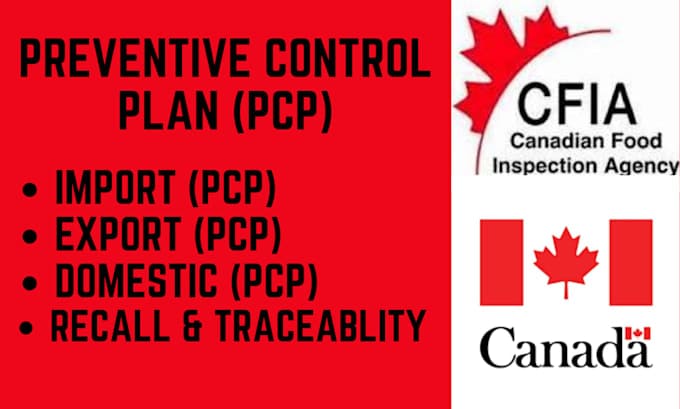
Canada enforces strict preventive control requirements to minimize food safety risks. Exporters must develop and implement a Preventive Control Plan (PCP) that addresses:
- Proper handling – Ensure raw and finished products are managed under sanitary conditions to prevent contamination.
- Storage conditions – Maintain temperature and humidity controls based on product type (e.g., frozen seafood at -18°C or lower).
- Transport procedures – Use clean, well-maintained containers and vehicles. Perishable goods should have temperature monitoring during transit.
- Shelf-life management – Clearly define “best before” or “expiry” dates and ensure they are accurate based on product stability tests.
Pro tip: A strong PCP not only helps with Canadian compliance but can also support faster customs clearance in other markets.
1.4 Traceability
Traceability is a legal requirement under SFCR, ensuring quick action in case of recalls or food safety incidents.
- One step back, one step forward – You must be able to identify the immediate supplier of your product ingredients and the immediate buyer/distributor of your finished goods.
- Record-keeping – Keep digital or physical records for at least 2 years (or longer for certain products) detailing batch numbers, production dates, and shipment information.
- Recall readiness – Maintain a documented recall procedure that allows you to remove affected products from the market quickly and efficiently.
- From origin to distribution – Ensure traceability covers the entire journey of the product, including processing plants, storage facilities, and transportation routes.
Pro tip: Many Canadian buyers prefer exporters who use GS1 barcoding standards for traceability, as it integrates smoothly with Canadian retail systems.
ISF: Complete Guide to Importer Security Filing (10+2) Requirements
Step 2 – Obtain Necessary Export Documents
Before shipping any food products to Canada, you must prepare the correct export documentation to satisfy both Canadian authorities and your importer’s requirements. Missing or incomplete paperwork can lead to costly delays, rejection at the border, or even permanent loss of market access.
2.1 Export Certificate Request Form
The Export Certificate Request Form is the primary document you will need when applying for CFIA-issued export certificates.
- Submission method – This form must be submitted via the My CFIA online portal, which acts as your official communication channel with the Canadian Food Inspection Agency.
- Key contents – The form requires accurate details about:
- Product description, including scientific/common name.
- Origin of the product (country and facility).
- Destination details (Canadian importer, final destination province, etc.).
- Supporting documentation – In most cases, you will need to upload:
- Laboratory test reports showing compliance with safety standards (e.g., microbiological analysis, chemical residue testing).
- Full ingredient lists and formulations.
- Packaging and labeling samples for review.
Pro tip: Fill out the form using the exact terminology found in CFIA regulations to avoid clarification requests that could slow approval.
2.2 Certificate of Free Sale (CFS)
The Certificate of Free Sale is an official document that verifies your product is legally manufactured and sold in your country of origin.
- Purpose – It assures Canadian authorities and buyers that your product meets the domestic regulations of your exporting country.
- When it’s required – Commonly requested for:
- Processed foods such as snacks, canned goods, or beverages.
- Packaged goods with multiple ingredients, especially those making nutritional or health claims.
- Issuing authority – Typically provided by:
- Your country’s food regulatory body.
- Local chambers of commerce or industry associations, depending on national rules.
Pro tip: Even if your importer says a CFS is “optional,” having one ready can smooth customs clearance and strengthen buyer confidence.
2.3 Other Certifications
Depending on your product type, marketing claims, and target market segment within Canada, you may need additional certifications:
- Organic Certification – Required if you plan to market your product as “organic.” Must be issued by a certification body recognized by the Canada Organic Regime.
- Halal or Kosher Certificates – Essential if you want to target religious or cultural consumer groups in Canada, especially in provinces like Ontario and Quebec.
- Phytosanitary Certificate – Required for fresh produce, grains, nuts, and other plant-based products to confirm they are free from pests and diseases. This is issued by the plant health authority in your country of origin.
- Health Certificates – May be required for certain animal-derived products, ensuring they meet Canada’s animal health and safety standards.
Pro tip: Check CFIA’s Automated Import Reference System (AIRS) before every shipment, as required certifications can change depending on seasonal pest risks or updated Canadian health advisories.
Step 3 – Meet Canadian Import Requirements
Even though you are the exporter from another country, your shipment’s success depends heavily on the Canadian importer meeting all domestic requirements. If your importer fails to comply with the Canadian Food Inspection Agency (CFIA) or other relevant authorities, your goods can be delayed, refused entry, or destroyed.
3.1 Import Permits
Some food categories require specific import permits before they can be brought into Canada. These are usually mandatory for high-risk products, including:
- Meat and meat products (fresh, frozen, or processed).
- Dairy products (milk, cheese, yogurt) subject to Canada’s supply management rules.
- Eggs and egg products (liquid egg, powdered egg).
- Certain fresh produce that may be subject to seasonal phytosanitary restrictions.
Key points:
- Import permits must be obtained by the Canadian importer, not the foreign exporter.
- The permit application is usually handled through the My CFIA portal or via specific CFIA forms.
- Without a valid permit, your shipment will be held at the border until documentation is provided—or returned at your cost.
Pro tip: Work closely with your Canadian importer to confirm that all necessary permits are secured before your goods leave your facility.
3.2 Product Evaluation & Border Inspection
When your shipment arrives in Canada, it may be subject to inspection and evaluation by either the CFIA or the Canada Border Services Agency (CBSA).
Typical checks include:
- Visual inspection of the product and packaging for damage, labeling accuracy, and tampering.
- Sampling and laboratory testing for contaminants, pathogens, or ingredient verification.
- Document verification to ensure certificates, permits, and declarations match the shipment contents.
If issues are detected, the CFIA may request:
- Additional test results from accredited laboratories.
- Revised documents to correct errors or missing details.
Pro tip: Always keep digital and hard copies of every certificate and test result. Quick document retrieval can shorten inspection times and reduce storage fees.
3.3 Foreign Facility Audits
For certain high-risk foods (especially animal products), Canadian authorities may require an audit of your production facility before approving exports to Canada.
- Audit scope – Canadian inspectors review hygiene practices, preventive controls, quality assurance programs, and record-keeping.
- Approval process – Some products can only be exported from facilities listed on Canada’s approved establishment list.
- Frequency – Audits can be one-time before approval or periodic, depending on product risk and trade agreements.
Pro tip: Maintain your facility in continuous audit readiness by following Good Manufacturing Practices (GMPs) and keeping your Hazard Analysis Critical Control Point (HACCP) plan up to date.
SCAC Code: The Complete Guide to Standard Carrier Alpha Codes
Step 4 – Comply with Canadian Labeling Rules
Before your food products can be sold in Canada, they must meet strict labeling requirements set out under the Food and Drugs Act, the Safe Food for Canadians Regulations (SFCR), and the Consumer Packaging and Labelling Act. Failure to comply can result in goods being detained, relabeled at your cost, or refused entry.
4.1 Bilingual Labeling – English & French
All mandatory information on the label must appear in both English and French, except for:
-
- Certain brand names or proper names that do not require translation.
- Specific technical terms with no equivalent in one language.
Text must be clear, legible, and of equal prominence in both languages.
Pro tip: Use a professional translation service familiar with Canadian food labeling to avoid errors that could trigger CFIA rejection.
4.2 Mandatory Information on Labels
The following details are required by law for most prepackaged foods:
- Common name of the food – Generic description (e.g., “chocolate chip cookies” instead of brand name only).
- List of ingredients – In descending order by weight, including sub-ingredients.
- Allergen declaration – Must follow Canada’s priority allergen list (e.g., peanuts, milk, gluten sources, soy).
- Net quantity – In metric units (grams, kilograms, millilitres, litres).
- Name and address of the Canadian importer – Even if you are the exporter, this must be the importer’s details.
- Nutrition Facts table – Must follow Canada’s standardized format, not the U.S. or EU version.
- Durable life date – “Best Before” or “Use By” date for products with a shelf life of 90 days or less.
Pro tip: Even if your product has a long shelf life, including a best-before date can increase consumer trust in Canada.
4.3 Claims and Marketing Statements
Canada has strict rules to prevent misleading claims:
- Organic – Only products certified to Canadian Organic Standards (or an equivalent recognized under a trade agreement) can display the “Canada Organic” logo.
- Natural – Cannot contain synthetic additives, preservatives, or artificial processing methods.
- Low-fat / Sugar-free / Gluten-free – Must meet precise nutrient content thresholds defined by CFIA.
- Health claims – Must be backed by scientific evidence and approved phrasing.
Pro tip: Never copy marketing claims from other countries’ packaging. Canada’s definitions and thresholds may differ significantly from the U.S., EU, or Asia.
Step 5 – Plan Shipping and Logistics

Efficient shipping and logistics planning is critical to ensure your food products reach Canada on time, in perfect condition, and without customs delays. This step combines accurate documentation, compliance with transport regulations, and proper handling for perishable goods.
5.1 HS Code Classification
Assign the correct Harmonized System (HS) code to your product.
This classification determines:
-
- Applicable tariff rates.
- Import restrictions or permits required.
- Eligibility for trade agreement benefits (e.g., under CUSMA).
Use the Canadian Customs Tariff database or consult a customs broker to ensure accuracy.
Pro tip: A wrong HS code can cause costly border delays or penalties.
5.2 Shipping Documentation Checklist
Your shipment must include complete and consistent paperwork:
- Bill of Lading (B/L) – Proof of shipment and transport details.
- Commercial Invoice – Declares product value, HS code, and seller/buyer details.
- Packing List – Specifies quantity, weight, and packaging details.
- Export Declaration – Filed via the Canadian Export Reporting System (CERS) if required.
- Any CFIA-issued certificates – Such as Export Certificates, Organic Certification, or Phytosanitary Certificate.
Pro tip: Keep digital copies of all documents ready for quick submission to customs or freight forwarders.
5.3 Temperature Control for Perishable Goods
- Perishable products must be transported in refrigerated (reefer) containers.
- Temperature logs may be required for CFIA verification.
- Follow the Cold Chain Management standards to maintain quality during transit.
Pro tip: Use data loggers inside containers to record temperature and humidity for proof of compliance.
5.4 Storage and Distribution in Canada
Arrange for warehousing facilities that can meet:
-
- Temperature requirements for frozen, chilled, or ambient goods.
- Humidity control for products like grains or dried foods.
Consider bonded warehouses if you want to store goods before customs clearance.
Coordinate with local distributors to minimize storage time and maintain freshness.
Pro tip: If you’re targeting multiple provinces, choose a centrally located warehouse (e.g., in Ontario or Quebec) for faster distribution.
Step 6 – Understand Costs and Fees
When exporting food products to Canada, it’s essential to have a clear cost breakdown to avoid unexpected expenses and maintain profitability. Costs generally fall into three main categories: regulatory and certification fees, customs duties and taxes, and logistics expenses.
6.1 CFIA Service Fees

The Canadian Food Inspection Agency (CFIA) charges various service fees that exporters should budget for:
- Inspection fees – Charged when products are inspected prior to export or upon arrival in Canada. Fees may vary by product type and inspection frequency (e.g., meat, seafood, dairy often have higher inspection requirements).
- Certificate issuance fees – Applicable for export certificates, sanitary/phytosanitary certificates, or organic certification documents.
- Laboratory testing fees – Required if the CFIA needs to verify food safety or quality through lab analysis.
Pro Tip: Register for and manage all requests through the My CFIA portal to streamline applications, avoid delays, and reduce the risk of late submission penalties.
6.2 Customs Duties and Taxes
Customs duties depend on:
- HS code (Harmonized System code) – Determines the tariff rate for your specific product.
- Country of origin – Canada’s trade agreements can reduce or eliminate duties if rules of origin are met.
Examples of relevant trade agreements:
- CPTPP (Comprehensive and Progressive Agreement for Trans-Pacific Partnership) – May offer duty-free access for qualifying goods from member countries.
- CUSMA (Canada–United States–Mexico Agreement) – Similar benefits for U.S. and Mexican products.
- CETA (Canada–European Union Comprehensive Economic and Trade Agreement) – Reduced duties for EU-origin goods.
Additional taxes may apply:
- GST (Goods and Services Tax) – 5% applied to most goods.
- PST/HST – Provincial taxes that vary by province. In HST provinces, GST and PST are combined into a single tax.
Pro Tip: Prepare a Certificate of Origin to claim preferential tariff rates under trade agreements.
6.3 Logistics Costs
Logistics expenses can be significant, especially for perishable goods:
- Freight rates – Depend on shipping method (air, sea, or land), seasonality, and fuel prices.
- Insurance – Protects your shipment from damage, theft, or loss during transit.
- Cold chain expenses – For temperature-sensitive products, this includes refrigerated containers, temperature monitoring devices, and humidity control systems.
- Warehousing fees – Storage costs in Canadian facilities, especially if goods are held pending inspection or customs clearance.
Pro Tip: Work with an experienced freight forwarder who specializes in Canadian food imports to optimize routes, negotiate better freight rates, and avoid costly delays.
Step 7 – Market Entry Strategies
Successfully entering the Canadian market requires more than just meeting regulatory requirements. To stand out and gain traction, exporters should adopt a strategic approach that blends market research, strong partnerships, and tailored sales channels.
7.1 Local Market Research
Before shipping your first container, invest time in understanding the Canadian food market landscape:
Identify target provinces:
Ontario – Canada’s most populous province, home to diverse urban markets like Toronto.
Quebec – Strong preference for French-language branding and locally inspired products.
British Columbia – Known for health-conscious consumers and strong demand for organic, plant-based, and Asian foods.
Understand consumer preferences:
Growing demand for organic, natural, allergen-free, and plant-based products.
Increased interest in sustainable packaging and fair-trade certifications.
Monitor dietary trends:
High protein snacks, functional beverages, and ethnic fusion foods are trending.
Many consumers are seeking clean-label products with transparent ingredient lists.
Pro Tip: Leverage Statistics Canada reports, Nielsen market data, and trade association insights (e.g., Canadian Agri-Food Trade Alliance) to identify gaps in the market.
7.2 Partner with a Canadian Importer
Your importer will be your gateway into the Canadian supply chain:
Choose strategically: Look for partners with established relationships in retail chains, specialty stores, and foodservice providers.
Verify compliance: Ensure your importer holds a valid Safe Food for Canadians (SFC) license, as this is mandatory for most food imports.
Evaluate distribution capabilities:
National reach for broad coverage.
Regional specialists for targeted penetration in niche markets.
Consider co-branding opportunities: Some importers may help with local packaging adaptation, labeling compliance, and marketing campaigns.
Pro Tip: Attend Canadian trade shows like SIAL Canada or Grocery Innovations Canada to meet importers face-to-face and negotiate partnerships.
7.3 Retail vs. Foodservice Channels
Choosing the right sales channel can determine how quickly your product gains traction:
Retail Market
Requires strong packaging design that complies with bilingual (English/French) labeling laws.
Marketing is key – invest in in-store promotions, sampling programs, and online advertising to drive consumer awareness.
Foodservice Sector
Focused on supplying restaurants, hotels, catering companies, and institutions.
Success depends on competitive pricing, reliable supply, and consistent quality.
Packaging may be in bulk formats rather than retail-ready units.
Pro Tip: Some exporters enter Canada through foodservice first, building brand recognition with chefs and restaurants before moving into retail shelves.
Common Challenges in Exporting to Canada
Exporting food products to Canada can be highly rewarding, but it comes with regulatory, logistical, and market challenges that can impact timelines and profitability. Understanding these potential pitfalls—and how to avoid them—can save you significant time and money.
Delays due to incomplete documentation
Missing certificates, inaccurate HS codes, or unverified product details can lead to shipment holds at the border. These delays can disrupt supply chains and result in penalties or product spoilage.
Solution: Double-check all required documents with your importer and a customs broker before shipment.
Non-compliance with labeling rules
Canada enforces strict bilingual (English/French) labeling standards under the Food and Drugs Act and Consumer Packaging and Labelling Act. Errors—such as incorrect nutrition tables, missing allergen declarations, or misleading claims—can trigger recalls, fines, or even a ban on future imports.
Solution: Have labels reviewed by a Canadian compliance consultant before printing.
Temperature abuse during transit
Perishable goods like seafood, dairy, or meat can lose quality or safety if temperature-controlled logistics fail.
Solution: Use GPS-enabled temperature monitoring and partner with logistics companies experienced in cold chain management.
High freight costs for perishable goods
Air freight and refrigerated shipping rates are often high, especially for small quantities. Seasonal demand spikes can further increase costs.
Solution: Consolidate shipments, negotiate long-term logistics contracts, or explore bonded warehouse storage in Canada to reduce frequency of shipments.
Tips for a Smooth Export Process
A proactive approach can help you streamline operations, avoid costly mistakes, and build trust with Canadian buyers.
- Work with a customs broker experienced in food imports
A good broker can navigate CFIA regulations, prepare import declarations, and liaise with border authorities on your behalf—reducing risk of shipment delays. - Test small shipments before scaling up
Sending a trial shipment allows you to identify unforeseen issues with packaging durability, customs clearance, or transit times—before committing to larger volumes. - Stay updated on CFIA regulatory changes
Food safety regulations can change, affecting labeling, permitted ingredients, or inspection protocols.
Tip: Subscribe to CFIA’s Food Safety Action Plan updates and follow industry trade groups. - Use My CFIA for streamlined administration
The My CFIA portal lets exporters and importers apply for permits, track certificate applications in real time, and communicate directly with CFIA officers—saving paperwork and email back-and-forth.
Frequently Asked Questions (FAQ)
What are the key steps to ensure compliant food export from Canada in 2025
The key steps to ensure compliant food export from Canada in 2025 are:
- Meet Canadian food safety and export requirements: Ensure the food product complies with Canadian safety, grading, labeling, packaging, and preparation standards. Implement a written preventive control plan (PCP) including hazard analysis, sanitation, and other safety measures.
- Understand and comply with foreign country requirements: Know the specific importing country’s rules. If Canadian standards differ from the importing country’s, provide documentation proving compliance with their rules.
- Obtain necessary licenses or registrations: Have a valid Canadian Food Inspection Agency (CFIA) export license or registration, if applicable.
- Apply for and secure CFIA export certification: Request an export certificate from CFIA before shipping to demonstrate regulatory oversight and compliance.
- Maintain traceability and documentation: Keep detailed records of safety controls, packaging, labeling, shipping conditions, and supplier food safety assurance programs as required.
- Comply with all export controls and inspection requirements: This includes controls on stamps, seals, lot number marking, and adherence to inspection and sampling protocols where applicable.
- Work with your importer and authorities on export requirements: This collaboration helps address any changes in foreign country rules and ensures product acceptance.
These steps are essential to comply with regulations under Canadian laws and to meet both Canadian and importing country requirements, avoiding shipment delays or refusals.
How can I verify foreign country requirements for food exports in Canada
To verify foreign country requirements for food exports from Canada, you should:
- Consult the CFIA Export Requirements Library, which provides specific destination country rules accepted by the Canadian government for export certification. This is the primary resource for known import requirements and conditions.
- Engage directly with your importer or specialized broker in the foreign country to understand detailed or updated requirements that may not yet be reflected in the CFIA library.
- Contact the Canadian Trade Commission or the CFIA Market Access Secretariat for assistance and guidance on importing country rules and eligibility criteria for export, especially if the foreign country’s requirements are unclear or not listed.
- Review official communications or websites of the foreign country’s competent authority (e.g., food safety or health authorities) to confirm up-to-date import regulations for your products.
- Keep documented evidence of your due diligence in verifying foreign requirements. If Canadian standards align with foreign rules, your preventive control plan (PCP) can serve as proof of compliance. For differences, obtain documentation demonstrating equivalence or acceptance from the importing country.
- Be aware that certain countries require approval of your establishment or product on specific export or eligibility lists, which may involve audits or additional certification processes coordinated via CFIA.
Following these steps ensures you meet foreign import requirements, reducing risks of shipment delays or refusals.
In summary, verify foreign country requirements through the CFIA Export Requirements Library, importer collaboration, Canadian Trade Commission or Market Access Secretariat support, and direct foreign authority consultation, supplemented by thorough documentation of compliance efforts.
How can I identify specific import certificates required by the foreign country
To identify specific import certificates required by a foreign country for your food exports, you should:
- Consult the importing country’s official authorities or websites: Many countries’ customs or trade departments publish requirements for import certificates (such as sanitary certificates, health certificates, or certificates of origin) necessary for different product types.
- Use government trade resources and export assistance portals: For example, the Canadian Food Inspection Agency (CFIA) Export Requirements Library or similar official trade portals provide documented lists of required certificates for various countries and products.
- Engage with your importer or freight forwarder in the foreign country: They often have practical, up-to-date knowledge of the specific certificates required for entry and can guide you accordingly.
- Contact trade commissions or consulates of the importing country: Embassies and consulates can clarify import documentation requirements and help with compliance.
- Review certificates typically required, such as:
- Certificates of origin (COO), which confirm product origin and may be generic or preferential if linked to free trade agreements.
- Sanitary, phytosanitary, or health certificates verifying compliance with safety standards.
- International Import Certificates, which some countries require to address export permits and approvals.
- Check trade agreements and specific tariff rules: Rules of origin and certificates for preferential tariffs must comply with trade agreement criteria and require careful verification.
In summary, the identification process involves official online resources, direct communication with importers and foreign authorities, and understanding of the relevant trade or health certifications required by the destination country for the specific food products you export.
How do I determine if a country requires a certificate of origin for my shipment
To determine if a country requires a Certificate of Origin (C/O) for your shipment, you should:
- Check the specific import regulations of the destination country, often found in that country’s customs tariff or trade regulations. Many countries list when a Certificate of Origin is mandatory for customs clearance.
- Consult official trade and customs resources, such as the importing country’s customs authority website or its trade department, to confirm if a C/O is needed for your product type.
- Use government trade databases like the Market Access Database (MADB) to find import conditions for various countries, including whether a C/O is required.
- Contact your importer or freight forwarder in the destination country, who usually have up-to-date knowledge of required certificates for shipments.
- Consider if your shipment benefits from preferential trade agreements, as a C/O is often required to claim reduced tariffs under Free Trade Agreements (FTAs). Examples include EU agreements, ASEAN agreements, or country-specific agreements.
- Confirm if the C/O is needed as part of a letter of credit or contractual requirement—sometimes importers or buyers require it as a condition for payment.
In short, the best approach is to verify through official customs or trade authority sources of the importing country, supplemented by consultation with your importer or trade representatives. Checking trade agreement requirements and specialized databases helps you identify whether a Certificate of Origin is needed for your specific shipment.