
Go West: Unlock Western Markets For Your Online Business (Webinar Recording)
Selling to US and Canadian shoppers takes more than listing your products. This session pairs US compliance with the payments and conversion side: what has to be in order before your goods are allowed in and your ads are allowed to run, and what Western consumers need to see before they trust a seller and complete a purchase.
Chapters
- 0:00The three barriers to selling in the US
- 0:31Barrier 1: customs and import paperwork
- 4:12Barrier 2: regulatory agencies (FDA, states, FTC)
- 6:52Barrier 3: ad platforms and influencers
- 10:03Three common mistakes brands make
- 17:25How G.O.L helps with US compliance
- 18:28PayPal and the Western online shopper
- 22:39Why carts get abandoned, and what lifts conversion
- 27:53Social media and influencers
- 34:13Building trust and matching channels to buyers
- 38:54Choosing your first Western market
- 41:59The takeaway
Who this webinar is for
Online sellers and brands in Asia that want to enter, or scale in, the US and Canadian markets — particularly those selling consumer goods such as cosmetics, supplements, food and fashion through their own website or marketplaces.
The three barriers to selling in the US
Tam frames US entry as three barriers you have to clear in order: customs, the regulatory agencies that cover your product, and the platforms you sell on.
1. Customs and import paperwork
Customs protects national security and collects duty, so your import documentation has to be complete and accurate. Three items are needed for your logistics provider: an importer of record (a US LLC or foreign importer of record, needed when stock goes into a US warehouse such as Amazon’s, but not for small packages shipped straight to consumers), a packing list with quantity, weight and description per package, and a commercial invoice with value, payment terms, buyer and seller. Duty is calculated from the packing list and invoice.
2. Regulatory agencies
Ask four questions of your product: is it regulated federally or state by state (alcohol, for example, is FDA-regulated federally but has state-level rules in places like New York and California); do you plan to sell in California, where Proposition 65 can require warning statements for listed ingredients; and do you advertise, in which case the FTC governs every claim you make.
3. Platforms and influencers
Ad platforms and social channels apply their own rules, increasingly with AI screening for non-compliant statements — a flagged claim can restrict your ads or get an account banned. Influencer content counts as your advertising. Tam’s supplement example: an influencer cannot say a gummy ‘treats hair loss’, but can share a personal experience such as thicker-looking hair after using it. Give influencers written guidance, keep import, testing and trademark records ready in case you need to appeal a restriction, and watch for platform policy changes.
Three common mistakes brands make
- Prohibited or unsubstantiated claims. Cosmetics cannot claim to treat a condition, so ‘cures acne’ and ‘treats dark spots’ are out, and skin-whitening claims are flagged as forbidden.
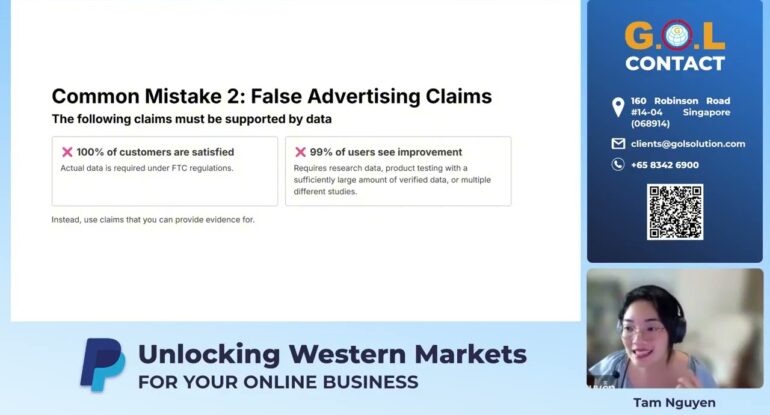
- False advertising. Statements like ‘100% of customers are satisfied’ or ‘99% saw improvement’ need real, unbiased evidence. Tam’s example was a hair-care client whose ‘clinically tested’ claim rested on a self-funded study of only 32 people — technically true to the report, but not adequate support under FTC rules.
- Labels that stray from the US format. Wrong label formats can get a shipment refused, returned or destroyed, and US shoppers expect familiar formats: Supplement Facts, Nutrition Facts, clear product origin (especially with tariffs in the news) and allergen or ingredient statements.
What the PayPal section covers
The second half, presented by Warren Hou of PayPal, moves from compliance to conversion. The key figures below were presented in the session by PayPal.
Why shoppers abandon carts
The reasons discussed were unexpected costs (high shipping, tax or fees), doubt about handing card details to an unfamiliar brand, and checkout friction such as forced account creation. In a survey of 15,000 people, high shipping cost was the leading reason for abandonment, followed by finding a cheaper alternative — which the speaker pointed out is an opening for smaller brands, since Western shoppers are prioritising price over brand loyalty.
What lifts conversion
Free delivery ranked first, followed by coupons or discounts, reviews, fast delivery, loyalty points, easy checkout, clear return policies and the option to split payments on pricier items. These reinforce one another, so combining several works better than relying on one.
Channels and influencers
Social media suits almost every demographic, though results vary by category — Instagram led for fashion, with YouTube, Facebook and TikTok following — while broadcast TV still leads for Gen X and baby boomers. Influencer purchases are driven by value for money (creator discount codes), product reputation and the trust an audience places in the creator.
Choosing your first Western market
| Market | What the session suggests |
|---|---|
| United States | Volume and velocity |
| United Kingdom | Trust and repeat purchases |
| Europe | Premium, higher-ticket products, with pay-later options to split the cost |
| Australia & New Zealand | PayPal wallet is the preferred way to pay online |
The closing takeaway from the PayPal side: to sell to the West, offer a payment brand shoppers already trust — and offer buy-now-pay-later, which has grown quickly in these markets.
Selling to the US? Get the compliance side sorted first
G.O.L Solution’s US team helps brands with FDA, MoCRA, labelling and import documentation, and with resolving shipments held at the port. Talk to an expert about your product.
Talk to an ExpertFrequently asked questions
What are the three barriers to selling into the US?
Customs (import paperwork, duties and national-security screening), the regulatory agencies that govern your product category, and the platforms and advertising channels you sell through.
What documents do I need to ship goods to the US?
A packing list showing quantity, weight and description per package, and a commercial invoice showing value, payment terms, buyer and seller. If you are sending stock into a US warehouse, you also need an importer of record such as a US LLC; you do not need one for small packages shipped directly to consumers.
Why are claims like ‘treats acne’ or ‘skin whitening’ a problem for cosmetics?
In the US a cosmetic cannot claim to treat a condition, disease or symptom, so wording like ‘treats acne’ or ‘treats dark spots’ is not allowed, and the webinar flags skin whitening claims as forbidden. Wording that is acceptable in your home market can be a violation under US rules.
Why do online shoppers abandon their carts?
According to the PayPal research presented, roughly 70% of online carts are abandoned before checkout. The reasons discussed were unexpected costs such as high shipping, tax or fees, hesitation about giving card details to an unfamiliar brand, and checkout friction such as forced account creation.
Which Western market should I start with?
The PayPal section suggests the US for volume and velocity, the UK or Australia and New Zealand for trust and repeat customers, and Europe for premium, higher-ticket products where pay-later options help. It is a starting framework, not a rule.
Read the full transcript
Auto-generated captions, lightly edited for readability. The recording is the authoritative version.
So this session I’m going to share about complying with US law. What are the common mistakes businesses should avoid to build consumer trust specifically for the US and could be adaptable to other market as well. For a business to sell in the US to just bring your product into the US from the compliant aspect I would look at it as there are three barriers that you must pass in order to reach this market. Number one is customs. Number two is regulatory agencies and number three are the platform that you’re selling. All right. The first barrier that you must think about when you want to sell to a new market US or any other market is customs. Custom is the one who basically to protect the national security of that country and they also the one collect tax related for products selling in their country.
So there are three preparation step to sell goods to the US. and the one key thing is that to ensure your import documentation is complete and accurate. selling domestically is quite simple, right? You you have a website or you have somewhere customer send an order in. You can order a grab or delivery express curate. They come pick up the product from you and then they just ship it. pretty hassle-free. But then when you look into selling overseas that same express courier who come pick up your products will ask you for documentations to ship it because yeah you will need certain paperwork to enter the other side. So for US market there are three components that you will need to prepare and provide to your your logistic provider in order to ship.
Number one is a foreign importer on record or US LLC basically a legal entity in the United States to bring to be the importer on the of the shipments. so this would you will need this if you are planning to send your product into a warehouse in the US like for example Amazon warehouse or you know ship into a local warehouse there so your shipping rate is lower you will need to have a entity to just clear customs if you’re shipping package like personal package or we call consumer package just from like let’s say Tam but Tam live in US and she ordered from your website, then she will be the importer or she’ll be the receiver on the package. So, you don’t need this number one if you’re just shipping direct package.
But because you know, as you might already know, if you ship per small package, the shipping rate could be very high. So a lot of time as your business grow your foreign operation you will need to you will need to optimize the shipping cost and the way to do it is to del ship a lot of your products to a local warehouse overseas and start shipping from there. So that the item number one, foreign importer of record or a US LLC is what you need to bring those products in. All right. And number two is packing list. Packing list is a detailed packing list showing the quantity, weight and description of the goods of each package. you will need all this because you will need to declare tax on it. you have to pay tariff on it depend on where the product’s coming from.
So you have to prepare all these items for your logistic provider. And number three is an invoice. So invoice the value, the payment term, the buyer, the seller information, you will also need to provide this as well. And based up the packing list and invoice, the US will be or any other market will be giving you an import tax on it. The second barrier that you need to keep in mind when it comes to the US is the regulatory agencies that regulate your market. so there are a few questions that you need to ask yourself or look up online to see which what will be applicable for your product. Number one is that is your product regulate on a federal level or state level in the US. Federal means na nationalwide that means there’s one agency that regulate your products nationalwide and state level because in the US there are 50 state there are certain products that are regulated differently state by state for example if your product is alcohol the product is regulated by FDA which is a federal or nationalwide agency for the product But depends on the state example New York or California there will be a state level requirements for your alcohol products to go to go into.
So you need to check which law agency will be regulating your products. the s yeah so I just explained the second questions and then the third question said do you plan to sell in California? Now, California is one of the biggest market for Asian-Americans if you’re targeting that market. And they also are one of the few state that always have a state level regulation. For example, if your product is food or cosmetic, you will need to look into something called Proposition 65 to see if your product’s ingredients are regulated in California differently. And pro proposition 65 is basically a requirement that your product must have u warning statements on it if the ingredients are considered harmful or may cause cancer or environmental u issues.
And then the last thing that you need to consider is that does your product have advertisings? are you planning to run ads online? Are you planning to sell on platform? Are you planning to throw on Google ads? Are you going to do TV? or do you have brochure? All that will be regulated by FTC which is the yeah the agency for advertising in the US. So if you do plan to advertise and I’m assuming that everyone all of us would like to do advertising then you will need to make sure that all the statements and the claims that you use on your advertise advertisement are compliant with FTC. All right. The la the third barrier that you need to keep in mind is platforms. this again go back to the ad advertisings advertising’s material or brochure or now with influencer marketing.
You might want to engage with a content creator or a key influencers to try your product, test it out and make a video about it and they will then post it on Facebook, Instagram, TikTok, YouTube etc. Then you will have to make sure that the influencers and the videos that they created also complying with advertising law. For example, in supplements you are not supposed to advertise your products let’s say treat hair loss, right? you have a supplements that is hair supplements and you and yeah so you don’t you cannot the influencer cannot say oh I this gummies is helping me treat my hair loss so that is a u non-compliance statement that the fuser cannot use but what they can be using is sharing their personal experience using the product for example they can say oh I have very thin hair from postpartum.
And since I used this gummy, I noticed that my hair is now like thicker, growing stronger. I have so many baby hair, etc. So, you have to really make sure that you give a proper guide to your influencers on what they can say on their advertising campaign. and it’s very important because nowadays these platform using AI to screen for non-compliance statement. So if the computer the algorithm found that oh whatever you say is not compliant to the US law they can restrict it you won’t able to run ads on it or maybe get banned as well. So keep that in mind and make sure that you have all the record all the origin all the documentation about your import your testing result your documentations your trademark etc.
Keep it those in hand so that if the worst case scenarios where these platform are restricted to make to ensure the quality on their platform you can provide it and appeal your case and one things that one the last thing you need to keep in mind about the platform is that they change the rules and the restriction quite often. So whichever platform that you pick to promote your products, you should keep an eye on the regulations and policies from them. All right. So what is the common mistakes that So now let’s go closer into the common mistakes. What are some of the common mistakes that brands are usually made when it come to the US market? number one number one common mistake as someone who as a company who help brands going to the US is that we found that they use a lot of prohibited or must be substantious claims when you when you advertise.
So a lot of the statements that is acceptable in your country might not be accepted in the US. For example, if you are a cosmetic brand, skincare brand and your product is to treat acne, maybe in your own country, you can say something like this product will cure your acne, right? But in the US, you are not allowed to use it if your product is under cosmetic. another statement that’s very commonly used is this product treats dark spot. Right? again cosmetic in the US are not supposed to treat any conditions or state that they any condition disease or symptoms. So dark spot by the US law is considered a conditions and cosmetic are not supposed to say that and you’re not supposed to use treats on it.
And the last items that a lot of maybe in Asia is quite popular is whitening your skin, right? So skin whitening is completely forbidden. All right. The second common mistakes that we h that a lot of brands make is false advertising. Now we all know that testimonials is a very good ways to build trust right 99% of the user who try this products are satisfied. we are getting 4.9 out of five star rating or in a lot of scenarios if your product is something that’s cosmetic or supplements etc then you will have something called oh maybe this product is clinically trial and everyone who use it is very happy. So one of my customers is a hair care product and basically they have this statement their product is clinically tested that 99% of the user have you have stronger hair and grew and able to beat hair loss because of their products.
But when we look into the actual clinical report, we found out that there’s two things. Number one, that clinical trial that they did that they are using is actually funded by them. So there is a conflict of interest there, right? And the second thing is the data size that they use was only 32 people, right? So if you have 32 people using the same product, you will probably have a higher probability that the product is going to work. But the data will show very different if their sample size are bigger like a thousand people, 500 or 1,000 people, right? So keep in mind even though those are technically true based on that report, but under FTC advertising rule is not accurate. I need to be supported with data that can be proven nonbiasely and so I would advise you to avoid statement like 100% of customer are satisfied because there’s nothing as definite right and also if you are using some kind of clinical trial like what I just share about the hair care scenario then you need to make sure that your your sample pool is big enough or using multiple different studies to proven in your claims.
All right, the last common mistake that a lot of brands usually also make is the product labels. Now in the US product labels have a certain format and this format is regulated by the agencies that product is under. If your product is food, supplements or cosmetic, there will be a certain format that you need to follow. and if you are if you stray away from that format, two things will happen. Number one, your products might get declined going into US because if the regulator inspect your product, inspect your shipment and they see the label is not accurate, they might decline and require you to you know return or destroy the shipment. The second thing that would happen is that the consumer won’t trust your your products because they are used to seeing if there’s if it’s a dietary supplements there will be a supplement facts on it.
If it’s a food product will be a nutrition facts on it and people do look at the labels before they buy the product. So if your product do not have those kind of format standardized based on US standard then consu a lot of the chance that the consumer won’t buy it. consumer in the US also don’t trust if the product do not have product origin especially now with tariff situations in place where they are very sensitive with you know foreign made products or US-made products having your product origins specifically state on you know your advertisement or on your labels is very important and last but not least is allergy informations so interestingly in the US onethird of the population have at least one kind of allergy conditions.
So if you are selling a products that will contacting the skin or getting ingested then eaten by the consumer make sure to have allergy statement on your label or at least ingredient statement so people who have different kind of allergy can check if they can use your product or not. Yep. So that is the end of my sessions about commonly mistake that a lot of brands make when it comes to building trust and complying with the US law. if you need help in you know building that trustworthy labels or statements or make sure that all the paperwork that we share earlier is good in order then we can help you with that. We are a US compliant expert that has more than 20 years of deep experience in US FDA law and MoCRA which is the US FDA law for cosmetic.
we do have a USbased office there so that we can support you with you know like a lot of cases where your goods getting held at the port or you know like there are you know questions from the agencies follow-up questions from the agencies about your record etc. We handle a lot of those case over the years. so we can help guide you or work with you to resolve those issues. And we also not only focusing on North America, we also have an arm working on compliance expertise in South Asia. So if you want to go cross border from from going into Thailand, Malaysia, Indonesia, Vietnam, the Philippines then we do have the experience of doing that as well. yeah and for the US market then we have done more than we have helped more than seven we have helped brand from seven different countries going to the US.
In this presentation that I have you guys, I will dabble more towards of course starting off with an introduction on PayPal. I’ll share with you the consumer trends especially in the western markets. I’ll share some tips and tricks on how you can optimize and convert consumers when they’re shopping on your site. And then lastly, some ideas and tips on cross-border expansion. So with that to kick start off, I’m sure everyone is very familiar with PayPal. So, PayPal is one of the well-known payment gateway across the globe. But a lot of times people tend to forget especially in our markets that PayPal is a consumer e-wallet as well. So take it from a perspective from wherever you are based currently whether it’s Philippines, Malaysia, Vietnam, Thailand.
I’m sure that there’s an e-wallet that you use every day for your payments, right? Whether it’s online, whether it’s offline, a payment e-wallet that you trust. So take it from a perspective from a western consumer, PayPal is that version of their trusted e-wallet that they use every day. So here at PayPal, as you can see from our screen, so we have over 434 million consumers using PayPal as an e-wallet. Then of course we have processed trillions in payment volume, billions in payment transaction, and of course we are across a multitude of countries. So with that, we at PayPal, we’re very familiar with how the payment landscape works. We have a lot of data on payments and of course insights on how consumer spending habit works from a payment perspective which I’ll go into more detail in the coming few slides.
So with PayPal right of course we have a multitude of products and basically payment products that businesses can leverage on but maybe just to give you a quick summary. So of course if you start on the left side of the slide here, PayPal can support online checkout, you know, whether it’s a website, whether it’s your inapps and whatnot. And of course, other products that we have are like our own buy now pay solution. Then of course we support enterprise in terms of their payments especially if they’re looking for a payment gateway. They can process more complex and higher volume. Then of course we also have other products that is available in person or in POS in the term. But of course it’s subject to specific regions of availability.
So it’s not available across all markets. But if you are interested you can just reach out and let me know. Then of course other products such as invoicing and payment links this is more tailored to businesses that you know maybe they don’t have an optimized website or they don’t have a website in general. And then of course lastly with the whole boom of AI the conversion of AI PayPal does adopt AI in terms of like helping enhance the consumer buying behavior or the buying preferences as well. So highlighting everything we PayPal is actually catered to all sizes of business whether or not you guys are starting out whether you’re solopreneur that you’re trying to grow your business or whether you’re a small business already and then you’re trying to scale even more and of course whether you’re already an enterprise business that is looking to have a more robust payment gateway that can support your business’s payments dayto-day.
Then of course I’m sure you guys are very familiar with a lot of the brands on here. So PayPal works with a lot of like the very top leading partners across the globe, the Nike of the world, the ticket master of the world. So we are highly likely partners of whichever solution that you’re already using for your business. Could be a website development platform. We could be integrated with them or maybe any solution that you’re using to run your business. we could be already integrated with them which makes it easier know whenever you want to adopt PayPal for your business. So that’s a very quick introduction of PayPal. so now what I’m going to do is to more share more about the consumer insights especially targeting the western markets and what our consumer data tells you to give you ideas maybe give you new strategies that you can think about when you want to expand to these markets.
So, I’m sure all of us here, we are shoppers, right? We shop online and we have our reasons why we abandon our carts. So, we did a research and we realized that 70% of online carts are abandoned before checkout, which is quite a very big number. And then there are four top reasons why. So, I’m sure that everyone can resonate with the reasons why. So for example the top reason is unexpected cost high shipping high tax or high fees like the case for myself I’ve also abandoned cart as well when I realize that hey shipping is too high or there’s fees or taxes that I feel like it’s too high it’s not worth it for me to then make the purchase anymore then subsequently the second top reason why is because when we shop online I’m sure we all shop online you most of the time you come across a brand that you might not be familiar with and then If you’re not familiar with this brand and you’re not familiar with their business, then highly likely there’s a sense of hesitation that oh is my card information safe to be presented to this business, right?
Because there’s a lot of fraud out there and all that. So that’s the second reason. And then the last the third and last reason is correlated in a way whereby how easy is it to check out? I’m sure some of you guys have come across like when you want to check out they ask you to create a account. You have to fill in a lot of details. You have to fill in your credit card details. You have to get the account verified which then makes me or makes yourself want to drop off because it’s too much effort, right? Just to make the purchase. So these are the top four reasons why. And then in the next statistics in this slide here, we are realizing that a lot of consumers in the western markets are now prioritizing price over brand loyalty than it used to be.
So in this chart here you can see that whenever a consumer decides to buy a product what’s the top thing that they will do is that they will research it online before they buy they tend to look for the best deals which correlates with hey are there any discount codes or coupons that can be used to make the purchase. So what this means as a smaller brand right because if you compare to the Nike of the world the Adidas of the world of course a lot of consumers know those brands but then when it comes to your brand this showcases that hey smaller brands have the advantage here because now consumers are shifting more to price rather than brand loyalty. So this is one idea in mind that you can think about whenever let’s say you are selling in fashion, you’re selling retail.
How can you be competitive compared to the big brands of the world? Then here are a few factors that is actually very good to take note of on how you can actually increase the conversion of a likelihood of your consumers purchasing from your website. So the top reason why is free delivery. I’m sure everyone can resonate with them. I recently made a purchase earlier today and because I saw free delivery, I decided to make the purchase because it helps, right? So free delivery is one of the top reasons why people convert and make the purchase online. Subsequently, you know, any coupons or discounts and then reviews followed by how fast is the delivery, any loyalty points, how easy it to check out, any return policy and of course any more reviews on social media you know from other platforms and how is it easy whether they can split the payments if especially it’s a more expensive product.
So all of these factors can correlate with each other. For example, like free delivery, coupons and discount and good reviews and next day delivery. Like as you see, if you include this top four top pointers and it all contributes to each other in a positive way, there’s a very increasing scale of consumers actually completing the purchase at the end of the day. Okay. So now here is where I’m sharing the reason why businesses or people abandon the cut right. So in this research here we concluded it across 15,000 people and then across that 15,000 people we actually g asked them question okay whether when they remember the last time they abandoned their card online. So as you can see within the last week 19% of them within the last two weeks 17% the last month is 16 and then the last three months is 15% and then lastly 33% of them don’t remember when they actually abandoned but then we got the reason why they decided to abandon the card and then it correlates back to shipping cost.
The main factor is because shipping cost is too high. And then the second top reason why is price because they found a cheaper alternative which is whereby I want to remind is where you know smaller brands can actually come in competitively compared to the big brands around across the globe. Then of course subsequently there are other main reasons why for example how long was the shipping the e the return policy whether or not the whole checkout experience is very smooth whether they had to create account and vice versa like you know fees taxes etc and how safe they felt when they make a purchase on a brand they didn’t know. So apologies about the format here. It seems like some words are overlapping.
but otherwise if you guys need all this information on consumer insights, feel free to let me know at the end of the webinar because I’m more than happy to share with you these insights for your reference. So here is where I move towards giving you some ideas on how you can expand especially with the different usage of different marketing channels. So I’m sure that everyone’s very familiar with social media right now, the Instagrams of the world, the TikTok of the world. So social media is a marketing channel that I would say all businesses should leverage on. And of course depending on what kind of demographics of customers you’re focusing on, then inhibits what kind of social media platform you should utilize more to target customers.
So with that we realized that social media is a very powerful tool for any brand to capture new customers but at the same time attract and hold customers as well. Okay so in this slide here right so there’s a comparison with AC across different platforms and the food for thought here is basically depending on the kind of product or services that you’re selling. So for example, if we take the first example, if that if you are selling fashion products online, then if you compare it across the different social media platforms, leveraging Instagram will yield the most will yield the most success in terms of like putting your product out there. Then of course followed by Facebook, followed by TikTok and surprisingly Pinterest as well for the fashion industry is actually pretty good to leverage on.
But the key takeaway here is that ideally you should be able or you should be utilizing as many social media platforms as you can. But of course different social media platforms will vary in terms of results, right? So it also depends at the end of the day the kind of products and services that you’re selling. So if we’re comparing it to the next vertical here such as home tech. So as you can see if you’re focusing on home tech generally across the board it’s quite standard like for Instagram you have the same levels of similar levels then Facebook and then TikTok. So these are just food for thought for you to take note of like what kind of social media platforms that you can use out ahead in terms of which kind of verticals you might be focusing on.
And then for example, if you look at the slide here, TikTok if you’re focusing on fashion has seen a very high increase in terms of like businesses leveraging to put their products out there. Okay. Then moving to the next slide. So correlating with social media platform, this is where influencers come into play. So influencers have a way of actually positively affecting or inhibiting the purchase behavior of your consumers. especially if the influencer is influencing a product that is related to your business. So, we did further research here and research shows that for example for if you’re targeting this Gen Z in the USA market, there’s a very high likelihood of 38% that they will actually make a purchase if it’s recommended by an influencer.
So, these are kind of key things that you might want to take note of that, hey, maybe it’s a good idea for me as a business to engage an influencer that promotes or is very familiar in the product or service that I’m selling in the US market, for example, so that you can actually open up more of your product into the market and get it more well, not say well known, but get more recognition on it. So in focusing on the clothing and gaming industry for example. So we noticed that influencers from all these different category has seen different results in term of like influencing the buyers behavior. So clothing if you’re selling fashion and clothing it seen that 40% 14% actually make a purchase when it’s influenced by an influencer and subsequently skincare, gaming, technology products like smartphone, makeup etc.
And then the reasons why consumers decide to purchase when it’s influenced by an influencer is because of the value for money. So what this means is because you know how influencers when they promote a product it normally comes with a discount. Hey quote my name for 10% off quote my name for 20% off. So they realize that hey it’s value for money here and subsequently it helps to boost the brand reputation represent reputation of the product that they’re showcasing or highlighting and also because the influencer will highly likely have developed a level of trust with the come with the kind of followings that they have following them. So as you can see it really correlates with each other. So when you leverage social media, you leverage influencers and how it can correlate to increasing the purchase behavior of your consumers and then okay so this slide here is showcasing the increase in influences in the different markets right so for example as you can see in the USA market following the green line from 2020 to 2024 there’s an increase of almost 10% of influencers coming to the market and then from there with that a lot more influencers will be able to influence the consumers into purchasing purchasing you know products and services online even if it’s the brand that is not known in their own country then of course you can correlated with the UK market how it’s been increasing then finally the Europe market right which is seen a bit more stable not say stagnant it’s slowly increasing but not as exponentially as compared to the other two markets then from the right side of the slide here you can see that the top verticals that seen a of influencers and how much they influence as well.
So music I think it’s quite understandable all the music artists out there that’s why they see a lot followings how they can actually easily influence their followers followed by food and nutrition news gaming etc all the way down to fashion. So the key thing to take note here is that social media is a platform that ideally should be utilized and then how can you correlate influencers as part of your marketing strategy. You know when you want to target a specific market for a specific product that you’re selling and how you can potentially increase the buyingness of consumers when they shop on your platform. Okay. So now moving up to the next session which is tips and tricks on how you can optimize or increase conversion or buying behavior onto your platform.
So the first thing first western markets highly likely a lot of times they are not familiar with your brand but they know PayPal. So coming back to the first slide right so PayPal is one of the most well in fact the most recognized e-wallet in the western market whereby a lot of consumers which is on our platform which is the 434 million resonate trust with the PayPal brand. So that is the first problem that we’re trying to solve here which is that 81% of online shoppers when they shop online with a brand they don’t recognize they feel the immediate hesitance of making the purchase which is where the PayPal as a fix as a brand recognition comes into play because PayPal is well known in those markets and that is where we can help increase the likelihood of a purchase just by the brand reput reputation and the brand awareness that we have in the western markets.
Okay. So, diving deeper into the social media space, right? So, the question here is that you should identify what kind of generations that you are targeting. Are you targeting the Gen Z, the millennials, the Gen X or the baby boomers. So across in this slide you can see different marketing channels and then from this slide you can roughly see that hey social media should be adopted across all the demographics that you are targeting in terms of which one is your consumer base. But there are food for thoughts here right? So for example, if most of your customers are the Gen X and the baby boomers, broadcast TV is still seen as the top marketing channel to be leveraged. But of course, social media is seeing an increasing trend in those those two demographics.
But otherwise, you can also take note of all the different channels and then correlate it with the kind of products and services that you’re selling. But let’s say for example, if you’re selling fashion, if you’re selling tangible goods, highly likely social media should be one of the top channels you should be adopting to actually promote your products and services. Okay. So, I’m going to take a spotlight on fashion here. I’m going to focus on it a bit more. So from all the social media channels that we have, if you are a business that is selling fashion products online, Instagram, Instagram is the top influencing social media platform that you as a brand should leverage on to actually promote your product.
Then of course followed by YouTube, followed by Facebook, TikTok and then subsequently all the other social media channels. So the reason for this is because a lot of times consumers will research the product online before actually making the purchase and then with what this means is that hey a lot of consumers are then deciding to make the purchase online more as compared to in store. So as you can see on the left hand side of the chart right when a consumer is thinking about making a purchase and when they discover the product online you can see that 41% of them actually then decide to make a purchase. So there’s a very increasing trend here but of course coming from a consumer’s perspective when you shop in store physically then of course when you see a product that you like you’re able to touch it you’re able to see it then the likelihood of you actually making the purchase increases well.
That’s why we’re still seeing that purchases made in store is still one of the top preferred channel and of course the highest percentage here. Okay. Now I’m going to spotlight in the technology and electronics goods sector. Right. So we realized that for this sector here a lot of consumers tend to prefer to shop online rather than in store. So of course there are different verticals here. You can see gifts, clothing, home appliances, kitchen appliances, etc., etc. But the top three categories that we see consumers preferring to shop online are technology, gifts, and clothing. So with that, another food for thought here, right? So there’s a reason why that a lot of consumers tend to shop online now and a reason why online shopping is something that you want to hammer down on and make a solid strategy in terms of like how you can grow your business especially in the different markets or especially in the western markets.
Okay. So now I’ve shared a lot of insights. So this is where I come I come to the part where some of the execution part that you can consider in terms of your strategy when you want to expand into the western markets. So I think it’s quite well known that a lot of the western markets consumers are already shopping online. So with that we did a research and actually 57% of the global online shoppers actually shop online and then with that there’s a projection of seven well there’s a increasing projection of e-commerce sales that is projected to increase in 2026 but then if you take a look last year by itself the e-commerce sales in 2025 the combination of it is bigger than a number of markets combined together 7.4 trillion and then this is where PayPal can come in to help assist your business expand in the western markets because of our consumer base that leverage our e-wallet from a day-to-day basis.
Okay. So depending on the market you’re focusing on right US, UK, Europe or AUNC, you want to know your buyers, your consumers before you actually ship. So of course when you take a look at United States a lot of times when the business focus on this country here they’re looking at volume and velocity but when you’re targeting United Kingdom the consumers are looking at trust and they’re more repeat friendly whereby if they like your brand they actually will come back and purchase more. Then when you look at the Europe region pay later is a prominent payment option that they tend to adopt especially if you’re targeting that region. And then when you look at Australia and New Zealand, PayPal e-wallet is still seen as the top preferred way that they like to spend or spend online in that sense.
So some ideas here and like how you want to consider when you entering the market. So this is where we would give you insights on like hey if you are targeting the US market for volume you can start with the US but if you’re looking for repeat value repeat customers then you might want to look at UK or AU and C and then if you’re looking for more premium customers where you’re selling a premium product and Europe but then of course leveraging the pay later option because when we say premium we’re we’re assuming that it’s a high ticket item right and pay later will help to come to split the payments accordingly which makes them feel at more at ease on their pocket when they make the purchase online.
And then with that with of course with PayPal we did more analysis and we reached out to the businesses to ask them like hey there’s an increase in conversion rate there’s a faster checkout speed and then with PayPal there’s a higher likelihood of a checkout completion for consumer shopping online. And then lastly, buy now pay later is an option that shouldn’t be nicer, but something businesses should adopt now, especially if you’re expanding to the western market because of how much it has grown from the start till now. And then to end off my presentation here because I’ve shared a lot. So the key takeaway or the key big idea here is that if you want to sell to the west, go with a brand that they already trust.
in terms of a payment perspective, that is PayPal. And then of course with PayPal is only a one-time integration. it’s one brand that is recognized across all the western markets and is a platform that is built for any business of size whether it’s a solar printer all the way to the enterprise