
How to Enter the Singapore Market Entry: The Complete Brand Guide (2026)
What The Singapore Market Entry Guide Covers
Singapore is the starting point most winning brands use to enter Southeast Asia. It has the fastest regulatory timelines in the region, world-class logistics infrastructure, and a business environment that lets you sell within days, not months.
This guide pulls together everything you need to know about entering Singapore, from product registration to e-commerce setup to fulfillment. Each section links to a deeper article where you can go further. If you are a brand owner evaluating Singapore for the first time, start here.
Why Singapore Is the Right First Market for SEA
Southeast Asia is not one market. It is eleven different regulatory systems operating under the same regional label. Supplement approvals in Malaysia take 6-9 months. Indonesia’s BPOM process runs 3-4 months. Vietnam is similar.
Singapore registers cosmetics in 2-3 days. Supplements can enter immediately with the right importer structure.
The smart move is to launch in Singapore first, start generating revenue, and run compliance paperwork for other markets in parallel. By the time Indonesia or Malaysia approves your products, you already have real sales data and proven demand.
This is the concurrent market entry model, and it changes the economics of SEA expansion entirely.
Read the full strategy: Singapore Market Entry Strategy: Why Marketplace Winners Use Singapore as Their SEA Hub
Registering Cosmetics for Singapore Market Entry
Cosmetics in Singapore go through a notification process under the Health Sciences Authority (HSA), following the ASEAN Cosmetic Directive. There is no pre-market approval waiting period. Once submitted and acknowledged, you can begin selling.
Submissions are made through HSA’s PRISM portal. To notify, you need four things: a local Singapore-registered company responsible for placing the product in the market, an authorized responsible person representing that company, a GMP Certificate from the manufacturer, and complete product details including formulation.
Current notification fees:
| Product Type | Single product or first 3 variants | 4th variant onwards |
|---|---|---|
| Eye, lip, oral/dental care products, or hair dyes with diamine compounds | SGD $28 | SGD $8 |
| All other cosmetics | SGD $13 | SGD $8 |
For brands without a Singapore-registered local company, GOL’s Importer on Record (IOR) solution covers this requirement and handles the notification process on your behalf, so you can enter the market without setting up a local entity.
Read the full guide: Registration of Cosmetics in Singapore: A Complete Guide for Businesses
Registering Health Supplements and Special Purpose Foods for Singapore Market Entry
Supplement and food registration in Singapore is more complex than cosmetics because two agencies are involved: HSA (Health Sciences Authority) for health supplements and SFA (Singapore Food Agency) for food supplements and functional foods.
The regulatory pathway your product takes depends on how it is presented and dosed. The classification tree below shows how Singapore determines which agency has jurisdiction over your product:
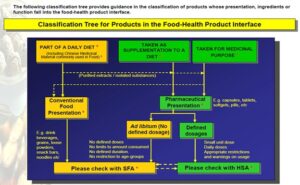
A turmeric product in capsule form with a defined daily dose goes through HSA. The same turmeric in powder sachet form mixed into a drink goes through SFA. Getting this classification wrong before filing is one of the most common and costly mistakes brands make.
Special purpose foods, including infant formulas, sports nutrition, and weight management products, sit under SFA and require more comprehensive documentation including stability studies and scientific substantiation for any health claims.
Read the full guide: Special Purpose Food Registration in Singapore: Complete Guide to Regulatory Compliance
Read the full case study for Supplement: Sell Supplements in Singapore Market Entry Study Case
Selling on TikTok Shop and Singapore Marketplaces for Singapore Market Entry
TikTok Shop achieved over USD 20 billion in gross merchandise value across Southeast Asia in 2023. Singapore is one of its most active markets and a natural first listing for brands entering the region.
To sell on TikTok Shop Singapore, you register as either an individual or corporate seller through the TikTok Shop Seller Center. Approval typically takes 2-7 business days. Products must comply with HSA or SFA requirements before listing.
Beyond TikTok Shop, Shopee and Lazada remain the two dominant marketplaces. GOL’s Merchant on Record (MOR) service handles marketplace account setup for brands without a local Singapore entity.
Read the step-by-step guide: How to Register as a Seller on TikTok Shop Singapore
Read the full marketplace guide in SEA: Which are the largest online marketplaces in Southeast Asia
Choosing the Right Fulfillment Partner for Singapore Market Entry
Once your products are cleared and your seller accounts are live, you need a fulfillment partner that matches your brand’s stage and strategy.
For DTC brands testing multiple SEA markets from Singapore, A2E handles cross-border fulfillment with customization options including branded inserts and influencer packs. For high-volume established brands optimizing cost, YCH Group offers advanced warehouse technology and an Asia-wide network. For early-stage brands who need reliable delivery without full 3PL commitment, DHL eCommerce Singapore is the practical starting point.
Fulfillment companies handle goods movement. What they cannot handle is the compliance and legal layer: import permits, product registration, label compliance, and marketplace seller setup. That layer needs to be sorted before your goods arrive at the warehouse.
Read the full guide: Top Fulfillment Companies in Singapore: How to Choose the Right Partner
Singapore as a Regional Trade Hub

Singapore exported USD 514.8 billion in goods in 2022. Its top trading partners span mainland China, Malaysia, the United States, Indonesia, and across ASEAN. The country’s port and airport infrastructure, transparent customs environment, and strategic central position in SEA make it the preferred regional distribution base for brands operating across multiple countries.
Read the full picture: Singapore’s Export Situation: Potential for Growth in the Future
Selling in Singapore Without a Local Entity: IOR, MOR, and SOR Explained
Most foreign brands entering Singapore don’t have a locally registered company. You don’t need one. Three services cover the legal and operational requirements on your behalf.
Importer on Record (IOR) is the local entity responsible for bringing your goods into Singapore. Every shipment entering Singapore requires a registered local importer. If you don’t have a Singapore company, GOL acts as your IOR handling customs clearance, import permits, and SFA or HSA documentation so your products can legally enter the country.
Merchant on Record (MOR) is the local entity required to open and operate seller accounts on Singapore marketplaces like Shopee, Lazada, and TikTok Shop. Marketplaces require a Singapore-registered business to hold the seller account. GOL’s MOR service provides this structure so your products can be listed without you incorporating locally.
Seller on Record (SOR) covers the broader e-commerce context: the entity that appears as the seller of record on transactions, handling tax obligations and consumer protection compliance in Singapore.
Most brands entering Singapore for the first time use IOR + MOR together. IOR gets your goods in. MOR gets them listed and sold.
Which Service Do You Need?
| Your situation | What you need |
|---|---|
| Shipping products into Singapore for the first time | IOR |
| Listing on Shopee, Lazada, or TikTok Shop | MOR |
| Running a DTC website (no marketplace) | IOR only |
| Selling on marketplaces AND DTC | IOR + MOR |
| Registering supplements or cosmetics with HSA/SFA | Product classification + IOR |
When Singapore Is NOT the Right First Market in SEA
The Singapore hub strategy does not work for every brand. Three situations where it fails: your product margin is too thin to absorb cross-border fulfillment costs (typically SGD 8-20 per parcel to Indonesia or Vietnam); your product requires local regulatory approval before any marketplace will list it; or your entire go-to-market depends on finding local distributors, not selling direct to consumers.
If any of these apply, registering directly in the target market first may be the more practical path.
Your Next Step: Expanding to Malaysia
For most brands that succeed in Singapore, Malaysia is the natural next market. It sits 350 kilometres away, shares the ASEAN Cosmetic Directive framework, and its cosmetics market is projected to exceed USD 3.2 billion by 2032.
The smarter approach is to start selling cross-border to Malaysia from your Singapore warehouse while the NPRA notification process runs in the background. Once approved, you transition to local fulfillment and marketplace listings.
Read the full guide: How to Enter the Malaysia Market for Cosmetics: The Complete Guide for Distributors and Brands
Ready to Launch in Singapore?
GOL handles regulatory compliance, IOR, product classification, fulfillment setup, and marketplace onboarding as a combined engagement. One team, one point of contact, from product assessment to first sale.
Talk to the GOL team about your Singapore market entry
Do I need a Singapore company to sell in Singapore?
No. GOL’s Importer on Record (IOR) service provides the local importer structure you need to bring products into Singapore without registering a local entity. Most international brands entering Singapore for the first time use this route.
How much does it cost to launch 10 Cosmetics SKUs in Singapore?
Based on our client engagements, launching 10 SKUs in Singapore using an IOR structure costs around SGD 3,500 with a 14-30 day timeline. This is lower than equivalent launches in Malaysia (SGD 8,000+) or Thailand (SGD 10,000+).
How do I know if my supplement is regulated by HSA or SFA?
It comes down to the product’s presentation format and dosing. Defined unit doses in capsule or tablet form route to HSA. Powder or liquid products without defined unit doses route to SFA. We recommend a product classification review before filing, as getting this wrong delays your launch and can result in rejected applications.
Can I sell to Malaysian customers before getting NPRA approval?
Yes, through your own website with inventory held in Singapore. Cross-border DTC sales to Malaysian consumers do not require NPRA notification. NPRA is required before listing on Shopee Malaysia, Lazada Malaysia, or TikTok Shop Malaysia.
How long does Singapore market entry take?
For most product categories, 4 to 6 weeks from engagement to first fulfilled order. This covers IOR setup (3-4 days), product classification, cosmetics notification through PRISM, and fulfillment partner onboarding. Regulated categories like health supplements under HSA may take longer if label adjustments are needed. The key advantage Singapore has over other SEA markets is that you can sell while paperwork is being processed, rather than waiting for approval before generating any revenue.
What products need registration or notification before selling in Singapore?
It depends on the category. Cosmetics require notification through HSA’s PRISM portal before selling. Food supplements and functional foods require an SFA import permit and must comply with Singapore’s Food Regulations. Health supplements listed with HSA are voluntary but carry significant credibility weight with consumers and marketplace operators. General food products require SFA import licensing. Products that do not make health or functional claims and are not cosmetics typically have a simpler import process. A product classification review before filing is the fastest way to determine exactly which pathway applies to your specific SKUs.
How do I sell on Shopee and Lazada in Singapore as a foreign brand?
Foreign brands need a Singapore-registered entity to open a seller account on Shopee or Lazada. If you do not have a local company, a Merchant on Record (MOR) service provides this structure. The MOR handles the seller account registration on your behalf, so your products can be listed under a compliant local entity without you needing to incorporate in Singapore. Products must also meet HSA or SFA compliance requirements before going live on any marketplace listing.
What does Singapore’s HSA (Health Sciences Authority) actually regulate?
HSA is Singapore’s health products regulator under the Health Products Act. It covers three categories most brands care about: cosmetics, health supplements, and medical devices.
Cosmetics: HSA requires a pre-market notification through PRISM, not a license. Products can be sold once notification is acknowledged.
Health supplements: HSA sets ingredient, dosage, and labelling rules. Registration itself is voluntary for most products.
Medical devices: A separate, risk-based registration and listing pathway applies. Products generally cannot be sold without it.
HSA does not cover food products with specific dietary functions, such as infant formula, diabetic food, or low-calorie food. Those are regulated by the Singapore Food Agency (SFA) instead.
Getting the category right before you file determines which pathway applies, and each carries a different timeline and cost.